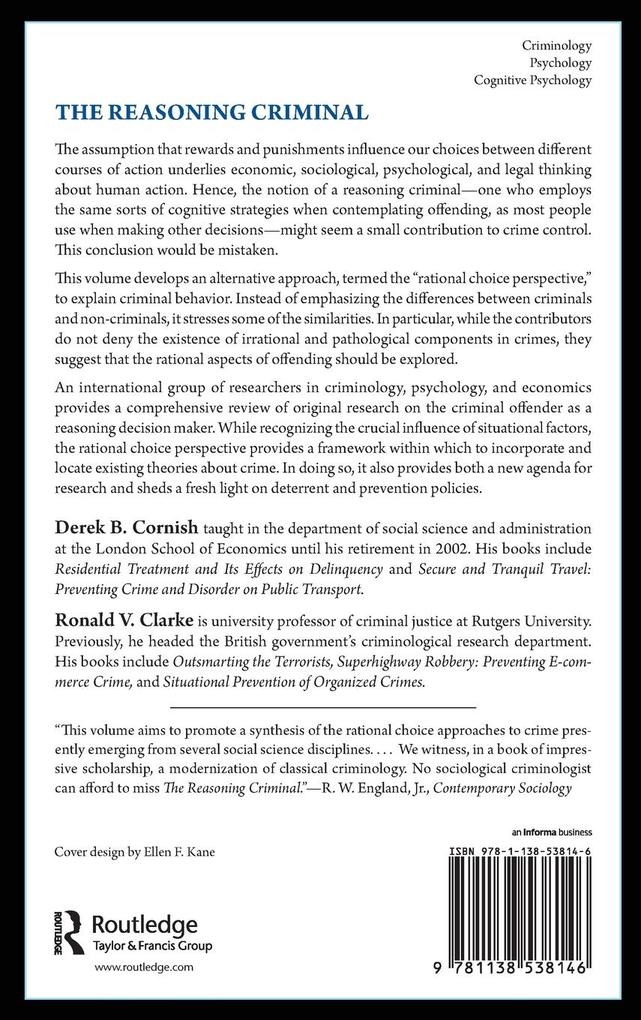
The assumption that rewards and punishments influence our choices between different courses of action underlies economic, sociological, psychological, and legal thinking about human action
Inhaltsverzeichnis
1: Introduction; 17: Part One Empirical Studies of Criminal Decision Making; 2: Shoplifters' Perceptions of Crime Opportunities: A Process-Tracing Study; 3: Victim Selection Procedures Among Economic Criminals: The Rational Choice Perspective; 4: Robbers as Decision-Makers; 5: The Decision to Give Up Crime 1; 6: A Decision-Making Approach to Opioid Addiction; Two: Theoretical Issues; 7: On the Compatibility of Rational Choice and Social Control Theories of Crime; 8: Linking Criminal Choices, Routine Activities, Informal Control, and Criminal Outcomes; 9: Models of Decision Making Under Uncertainty: The Criminal Choice; 10: The Theory of Reasoned Action: A Decision Theory of Crime; 11: The Decision to Commit a Crime: An Information-Processing Analysis; 12: Offense Specialization: Does It Exist?; 13: Criminal Incapacitation Effects Considered in an Adaptive Choice Framework; 14: Practical Reasoning and Criminal Responsibility: A Jurisprudential Approach