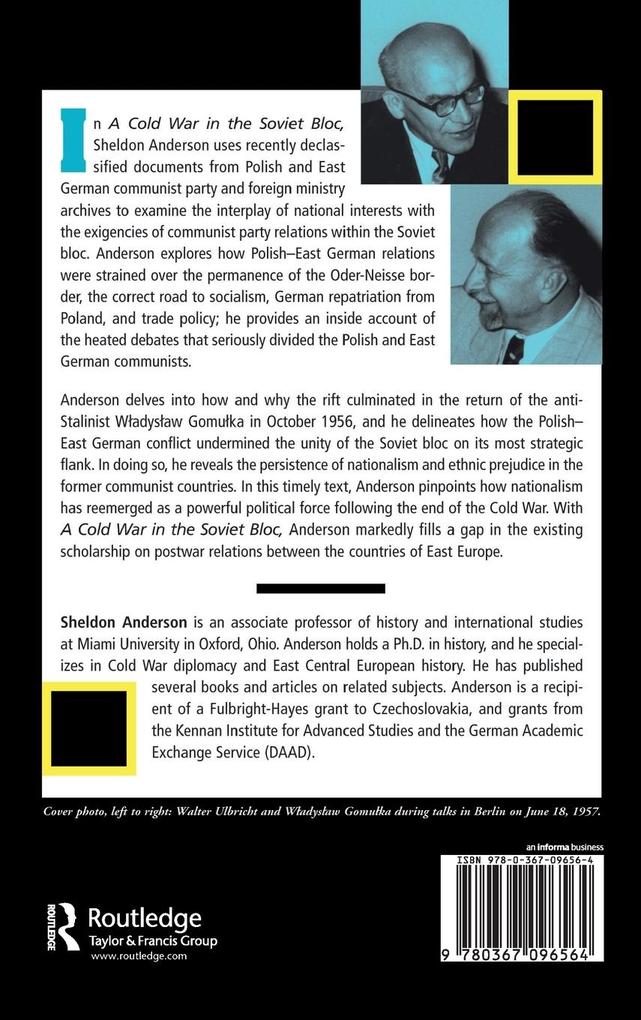
This book explores the Polish and East German communist parties' pursuit of conflicting national interests--rather than common socialist goals--during the height of the Cold War, and how this weakened the unity of the Soviet bloc.
Inhaltsverzeichnis
Introduction , "There Are No Good Germans": The Myth of Proletarian Internationalism, 1945-1949 , The Controversy over the Oder-Neisse Border, 1946-1949 , The Myth of the Stalinist Brotherhood, 1949-1954 , The Problems of German Repatriation, Reparations, and Trade, 1945-1953 , German Remilitarization and the Polish Thaw, 1954-1955 , Khrushchev's De-Stalinization Speech and Gomüka's Return to Power, January-October, 1956 , The Cold Winter of Polish-East German Relations, 1956-1957 , Gomüka's Trade Policies and the Recurring Problem of German Repatriation, 1953-1957 , Gomüka's Foreign Policy and the Ulbricht-Gomüka Summit, 1956-1957 , The Rapacki Plan and the German Question, 1957-1959 , The Right Road to Socialism and Ulbricht's Visit to Poland, 1958-1959 , The GDR as a Model for Polish Socialism, 1959-1961 , The Berlin Wall and the Détente in Polish-East German Relations, 1961-1962 , Conclusion