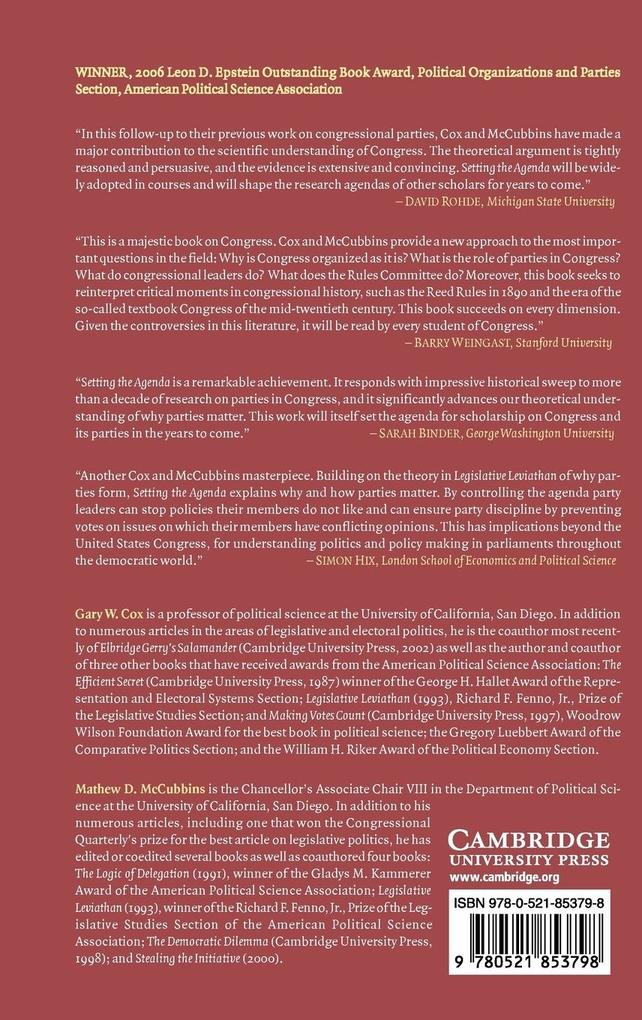
"In this follow up to their previous work on congressional parties, Cox and McCubbins have made a major contribution to the scientific understanding of Congress. The theoretical argument is tightly reasoned and persuasive, and the evidence is extensive and convincing. Setting the Agenda will be widely adopted in courses and will shape the research agendas of other scholars for years to come." David Rohde, Michigan State University "This is a majestic book on Congress. Cox and McCubbins provide a new approach to the most important questions in the field: Why is Congress organized as it is? What is the role of parties in Congress? What do congressional leaders do? What does the Rules Committee do? Moreover, this book seeks to reinterpret critical moments in congressional history, such as the Reed Rules in 1890 and the era of the so-called "textbook Congress" of the mid-twentieth century. This book succeeds on every dimension. Given the controversies in this literature, it will be read by every student of Congress." Barry Weingast, Stanford University "Setting the Agenda is a remarkable achievement. It responds with impressive historical sweep to more than a decade of research on parties in Congress, and it significantly advances our theoretical understanding of why parties matter. This work will itself set the agenda for scholarship on Congress and its parties in the years to come." Sarah Binder, George Washington University "Another Cox and McCubbins masterpiece. Building on the theory in Legislative Leviathan of why parties form, Setting the Agenda explains why and how parties matter. By controlling the agenda party leaders can stop policies their members do not like and can ensure party discipline by preventing votes on issues on which their members have conflicting opinions. This has implications beyond the US Congress, for understanding politics and policy-making in parliaments throughout the democratic world." Simon Hix, London School of Economics and Political Science "Cox and McCubbins make a powerful case for viewing agenda control as a persistent and fundamental dimension of party influence in the modern U.S. Congress. Even readers who may not be persuaded that this mode of analysis captures the full range of contributions parties and leaders make to congressional politics will benefit from a close reading of this study." - Randall Strahan, Emory University