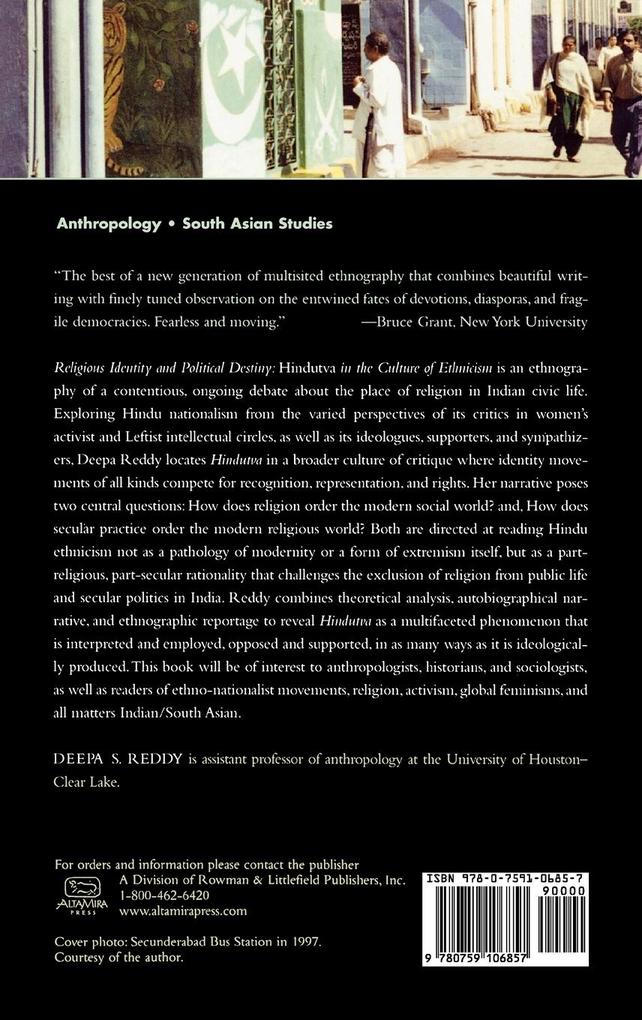
Starting from an initial ethnographic insight that highly contentious religious struggles had filtered into and transformed the politics of women's activism, Deepa Reddy's important new text moves into a broader appraisal of contemporary Indian politicalagendas and the critical intellectual discourses informing them. From a number of strategic sites in and around Hyderabad and New Delhi, she explores why and how Hindu nationalism, as espoused notably by the Bharatiya Janata Party (BJP), has emerged as acompelling response to the post-Independence secularist movements of Gandhi-Nehru dynasty of the Congress Party and of the Indian Left. She set an ambitious task for the text: creating an analytical position from which the fraught sensibilities-the innertruths-that animate Hindu nationalism can be viewed as persuasive and legitimate from the perspectives of diverse groups of activists and adherents. In so doing she must confront the secularists' positions, articulated within activist-academic circles that dismiss the aspirations of the BJP as pathological, she must also acknowledge the potential of Hindu nationalism to ignite communal violence. The astute reflexive moves that impel Reddy's analysis offer the reader multiple vantage points from which t -- Doug Holmes, Binghamton University The best of a new generation of multi-sited ethnography that combines beautiful writing with finely tuned observation on the entwined fates of devotions, diasporas, and fragile democracies. Fearless and moving. -- Bruce Grant, Associate Professor of Anthropology, New York University Starting from an initial ethnographic insight that highly contentious religious struggles had filtered into and transformed the politics of women's activism, Deepa Reddy's important new text moves into a broader appraisal of contemporary Indian political agendas and the critical intellectual discourses informing them. From a number of strategic sites in and around Hyderabad and New Delhi, she explores why and how Hindu nationalism, as espoused notably by the Bharatiya Janata Party (BJP), has emerged as a compelling response to the post-Independence secularist movements of Gandhi-Nehru dynasty of the Congress Party and of the Indian Left. She set an ambitious task for the text: creating an analytical position from which the fraught sensibilities-the inner truths-that animate Hindu nationalism can be viewed as persuasive and legitimate from the perspectives of diverse groups of activists and adherents. In so doing she must confront the secularists' positions, articulated within activist-academic circles that dismiss the aspirations of the BJP as "pathological," she must also acknowledge the potential of Hindu nationalism to ignite communal violence. The astute reflexive moves that impel Reddy's analysis offer the reader multiple vantage points from which to enter and to assess these debates. Her reflexive commitments premised on "passionate contraries," continually demand that the reader tackle the inherent complexity of these entangled political issues and their abiding contradictions. Reddy's vigorous experimentation with ethnographic method makes this book a major new addition to the Alterations series in anthropological writing. -- Doug Holmes, Binghamton University