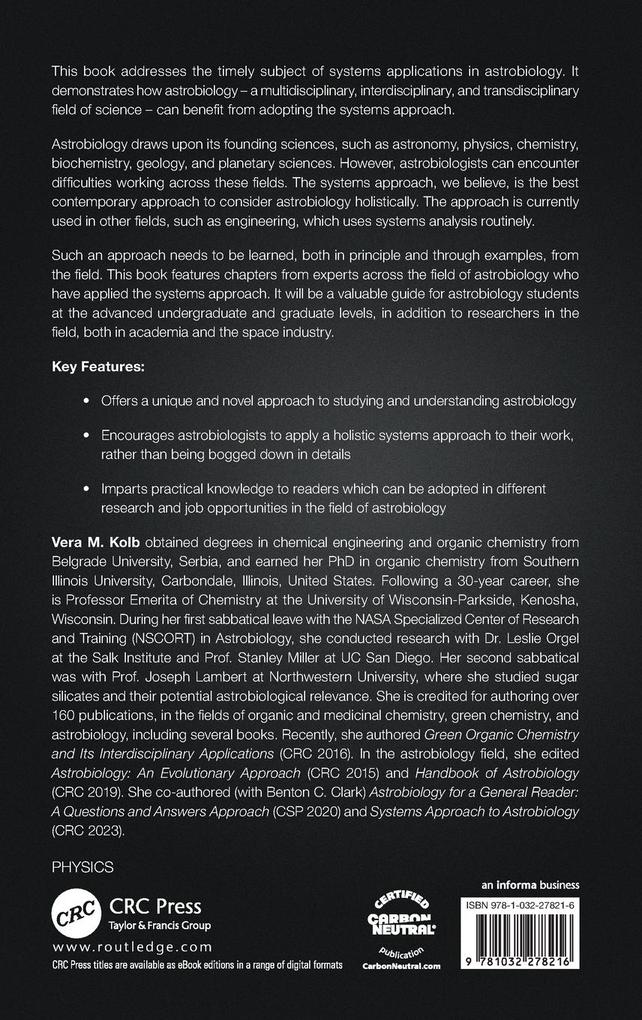
This book addresses the timely subject of systems applications in astrobiology. It demonstrates how astrobiology - a multidisciplinary, interdisciplinary, and transdisciplinary field of science - can benefit from adopting the systems approach.
Inhaltsverzeichnis
Chapter 1: Astrobiology: An overview. Chapter 2: A primer on the systems approach. Chapter 3: Systems approach to prebiotic chemistry which led to life. Chapter 4: Assembly of membranous compartments: An essential step in the emergence and function of protocells. Chapter 5: Locating the cradle of life: The hydrothermal impact crater lakes on young Earth and Mars. Chapter 6: Systems Geochemistry in Astrobiological Context. Chapter 7: Asymmetric autocatalysis and the origins of homochirality. Chapter 8: Abiotic-to-biotic transition of chemical systems starting with thermodynamic inversion. Chapter 9: Systems biology. Chapter 10: Systems approach to microbiology. Chapter 11: The role of astrobiology in systems thinking education. Chapter 12: Knowledge gaps in astrobiology: Can systems approach help elucidate them? Chapter 13: Life's emergence by protocellular mutually catalytic networks of small molecules. Chapter 14: Prototyping the colonizer cell: Combining biology and systems engineering.