Bücher versandkostenfrei*100 Tage Rückgaberecht***Abholung in über 100 Filialen

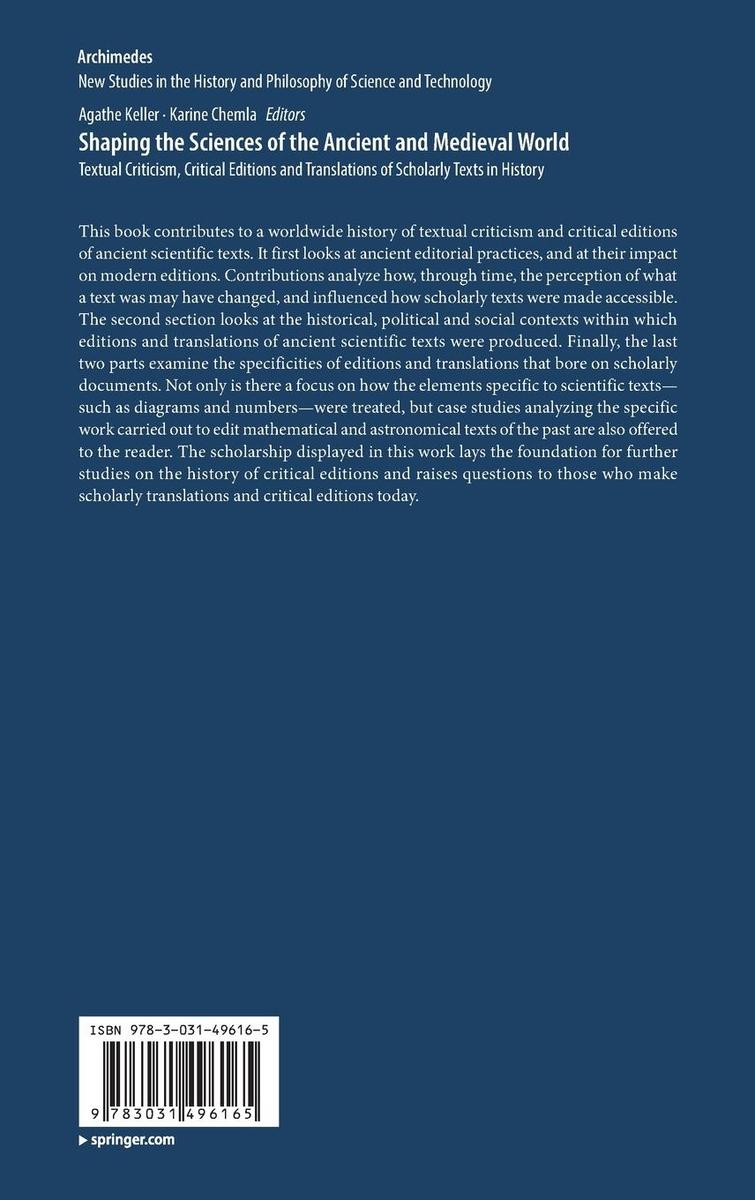
This book contributes to a worldwide history of textual criticism and critical editions of ancient scientific texts. It first looks at ancient editorial practices, and at their impact on modern editions. Contributions analyze how, through time, the perception of what a text was may have changed, and influenced how scholarly texts were made accessible. The second section looks at the historical, political and social contexts within which editions and translations of ancient scientific texts were produced. Finally, the last two parts examine the specificities of editions and translations that bore on scholarly documents. Not only is there a focus on how the elements specific to scientific texts-such as diagrams and numbers-were treated, but case studies analyzing the specific work carried out to edit mathematical and astronomical texts of the past are also offered to the reader. The scholarship displayed in this work lays the foundation for further studies on the history of critical editions and raises questions to those who make scholarly translations and critical editions today.
Inhaltsverzeichnis
Chapter 1. Introduction (Karine Chemla and Agathe Keller). - Part I: Ancient Editorial and Cross-Linguistic Practices. - Chapter 2. Before the Library of Babel: On some Very Early Philologers (Piotr Michalowski). - Chapter 3. A Theory of Philological Practice in Early Modern India (Sheldon Pollock). - Part II: What was at Issue in Returning to Ancient Texts in Early Modern and Modern Times? . - Chapter 4. Rethinking the Ancient Mathematical Text: Ming-Qing Scholars Critical Reflections on The Gnomon of Zhou [Dynasty] (Han Qi). - Chapter 5. The Asiatic Society, the Bibliotheca Indica and Devan gar Pinting in Bengal: The Historical Context of the Editio Princeps of the Ny yabh ya (Alessandro Graheli). - Chapter 6. Editing a Foundational Work on Classical Indian Medicine: The Printed Editions of the Carakasa hit in Context (Karin Preisendanz). - Part III: Shaping Specific Features of Scientific Texts. - Chapter 7. Representing numbers and quantities in editions of mathematical cuneiform texts (Christine Proust). - Chapter 8. Numbers and Quantities in Editions of Economic and Administrative Cuneiform Texts at the beginning of the 2nd millennium BCE. The Case of the Capacity System (Cecile Michel). - Chapter 9. Reduction of Absurdity: Notes on the editorial Transformations of Greek Diagrams (Reviel Netz). - Chapter 10. Editing the Sumerians, How and Why? (Jerrold S. Cooper). - Part IV: Publishing Ancient Mathematical and Astronomical texts: Comparative Perspectives. - Chapter 11. The critical edition of the mathematical texts of Greek Antiquity: challenges and method (Micheline Decorps). - Chapter 12. Shaping a Mathematical text in Sanskrit: H. T. Colebrooke, Sudh kara Dvivedin, and P th daka`s commentary on the twelfth chapter of the Br hmasphu asiddh nta (Agathe Keller). - Chapter 13. On the First Printed Edition of the Mathematical Book in Nine Chapters (1842) (Yiwen Zhu & Cheng Zheng). - Chapter 14. Babylonian Astronomy: Editing and Interpreting an Ancient Science (Matthieu Ossendrijver). - Chapter 15. Postface (Glenn Most). - Annexure. - Index.
The chapters of the volume under review offer an extraordinarily rich panorama of textual traditions across cultures and epochs. Its breadth is remarkable: it spans thousands of years, multiple writing systems, and a wide array of scientific disciplines. This book, well illustrated with original documents, is not only a major contribution to the history of science but also a methodological landmark, inviting readers to rethink what it means to study ancient and medieval scientific texts today. (Marc Moyon, zbMATH 1583. 01005, 2026)
The volume s greatest innovation is its global, comparative framework. Another notable strength is the book s interdisciplinary breadth, integrating insights from philology, history of science, archaeology, and cultural studies. the publication is undeniably a general-interest book for scholars in the history of science, philology, and cross-cultural studies. Its global perspective, rigorous scholarship, and critical insights into textual transmission challenge readers to rethink the authority of the texts that form the basis of our historical knowledge. (Limei Zhi and Yanmeng Wanga, Historia Mathematica, Vol. 74, 2026)
Es wurden noch keine Bewertungen abgegeben. Schreiben Sie die erste Bewertung zu "Shaping the Sciences of the Ancient and Medieval World" und helfen Sie damit anderen bei der Kaufentscheidung.











