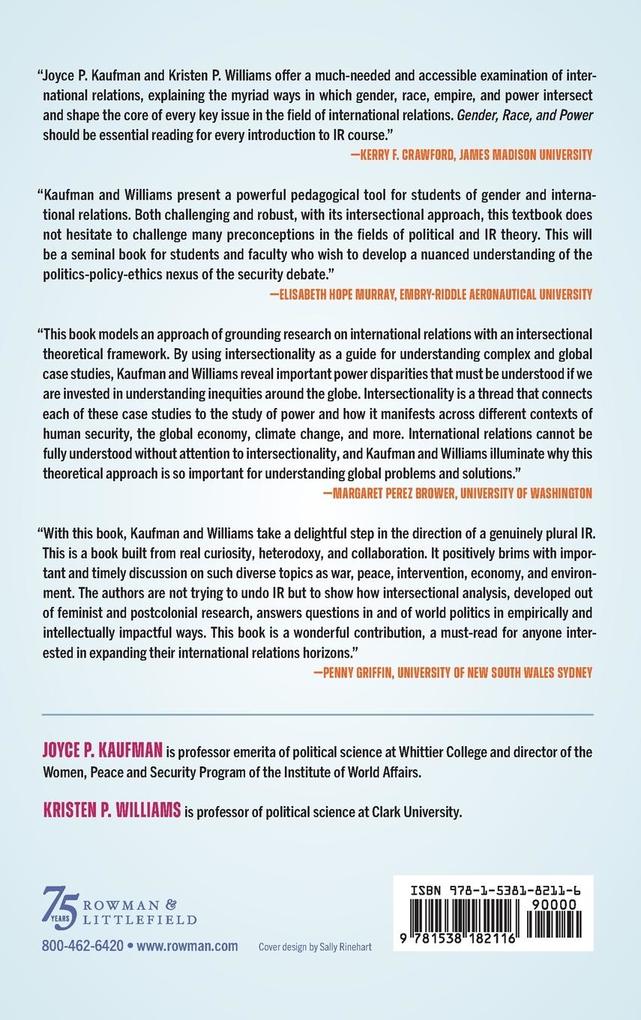
Kaufman and Williams present critical issues in international relations through an intersectional approach that examines race, gender, class, ethnicity, and power to arrive at better explanations for such core IR issues as war and peace, security, human rights, development and international political economy, and the global environment.
Their approach builds on early calls amongst feminist IR theorists, imploring "Where are the women?" It is only fairly recently that students of IR have broadened the approach to the field to incorporate the dimensions of race, ethnicity, and class as well as gender. Kaufman and Williams help guide readers exploring questions like: How does gender matter for understanding war and peace? How does race matter? Where are the men? What is intersectionality in IR? How does an intersectional approach change or broaden our understanding of international relations?
Inhaltsverzeichnis
List of Text Boxes< BR> Preface< BR> List of Abbreviations< BR> Introduction< BR> Chapter 1: Intersectionality and IR< BR> Introduction: Starting with the War in Ukraine< BR> Intersectionality and IR< BR> Mainstream IR Theories: Realism, Liberalism, and Constructivism< BR> Critiques of Mainstream IR: Race, Gender, and Empire-and Intersectionality< BR> Conclusion: Overview of Chapters 2-6< BR> Chapter 2: Intersectionality and Issues of War, Peace, and Security< BR> Introduction< BR> What is War? < BR> What is Peace? < BR> War and Peace from an Intersectional Perspective: Human Security< BR> The Women, Peace, and Security Agenda and UNSCR 1325< BR> Critiques of UNSCR 1325: Intersectionality Matters< BR> Intersectional Analysis: Northern Ireland as a Case Study< BR> Conclusion< BR> Chapter 3: Intersectionality, Human Rights, and Humanitarian Intervention< BR> Introduction< BR> Human Rights as a Concept and a Norm< BR> Women and Their Impact on the UN Charter and UDHR< BR> UDHR and Human Rights from an Intersectional Perspective< BR> Applying an Intersectional Analysis: CEDAW as a Case Study< BR> Humanitarian Intervention and the Responsibility to Protect (R2P)< BR> Conclusion< BR> Chapter 4: Intersectionality, the Global Economy, and Issues of Development< BR> Introduction< BR> IR Approaches to the Global Economy< BR> Gendering Development: WID, WAD, and GAD< BR> Global Health and Economic Development: COVID-19 as a Case Study< BR> Conclusion< BR> Chapter 5: Intersectionality and the Environment< BR> Introduction< BR> Development and Evolution of International Environmental Politics< BR> International Relations and the Environment< BR> Intersectionality and International/Global Environmental Politics< BR> Case Study: Intersectionality and Climate Change< BR> Gendering Climate Change and Global Governance< BR> Conclusion< BR> Chapter 6: Examining IR from an Intersectional Perspective: Lessons Learned< BR> Introduction< BR> Answering the Questions< BR> Intersectionality and the Case Studies< BR> Conclusion: The Challenges and Possible Next Steps< BR> Glossary< BR> About the Authors