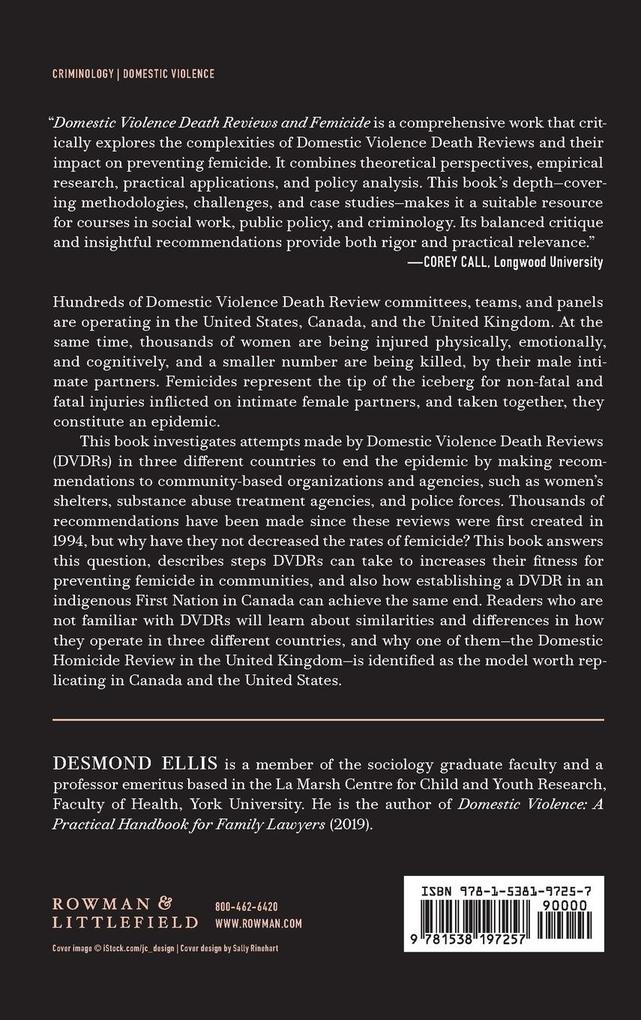
Hundreds of Domestic Violence Death Review committees, teams, and panels are operating in the United States, Canada and the United Kingdom. At the same time, thousands of women are being injured physically, emotionally, and cognitively, and a smaller number are being killed, by their male intimate partners. Femicides represent the tip of the iceberg for non-fatal and fatal injuries inflicted on intimate female partners, and taken together, they constitute an epidemic.
This book investigates attempts made by Domestic Violence Death Reviews (DVDRs) in three different countries to end the epidemic by making recommendations to community-based organizations and agencies, such as women's shelters, substance abuse treatment agencies, and police forces. Thousands of recommendations have been made since these reviews were first created in 1994, but why have they not decreased the rates of femicide? This book answers this question, describes steps DVDRs can take to increases their fitness for preventing femicide in communities, and also how establishing a DVDR in an indigenous First Nation in Canada can achieve the same end. Readers who are not familiar with DVDRs will learn about similarities and differences in how they operate in three different countries, and why one of them-the Domestic Homicide Review in the United Kingdom-is identified as the model worth replicating in Canada and the United States.
Inhaltsverzeichnis
Introduction< BR> Goal and Purposes< BR> Organization< BR> Summary and Lessons Learned < BR> Chapter 1: Definitions< BR> Homicide < BR> Homicide-suicide< BR> Femicide < BR> Social Issues < BR> Purposes< BR> Summary and Lessons Learned< BR> Chapter 2: History< BR> Media Publicity < BR> System Gaps < BR> Alternative Models < BR> Legislation < BR> Summary and Lessons Learned < BR> Chapter 3: Theory< BR> Patriarchy Theory< BR> Systems Theory< BR> Ecological Theory< BR> Proprietariness Theory< BR> Summary and Lessons Learned < BR> Chapter 4: Research < BR> Sample Selection < BR> Findings < BR> Evaluation < BR> Recommendations < BR> Summary and Lessons Learned < BR> Chapter 5: Implications for Practice < BR> Coronial Rule< BR> Study Design < BR> Definitions < BR> Data Collection < BR> Data Analysis < BR> Risk Factors < BR> Protective Factors < BR> Selection of Homicide Cases < BR> Selection of Advisory Group Members < BR> Contradictory Objective < BR> Hierarchy of Voice < BR> Public Awareness < BR> Dilemmas < BR> Accountability < BR> Evaluation < BR> Inter-agency Collaboration: DHR and CCR< BR> Femicide-suicide < BR> Arguments< BR> Summary and Lessons Learned< BR> Chapter 6: The Barriers Thesis< BR> Definitions < BR> Conceptual < BR> Empirical < BR> Implications < BR> Summary and lessons learned < BR> Chapter 7: Domestic Violence Homicide Reviews and Indigenous Peoples< BR> Introduction< BR> Nomenclature < BR> Findings< BR> Settler Colonization Theory < BR> Application< BR> Problems < BR> Prospects< BR> Postscript< BR> Summary and Lessons Learned < BR> Chapter 8: Case Studies< BR> Introduction < BR> The West Berkshire Safer Communities Partnership (CSP/DHR)< BR> Ontario Domestic Violence Death Review Committee< BR> Santa Clara Domestic Violence Death Review Team< BR> Summary and Lessons Learned < BR> Conclusions < BR> Chapter 9: Policy< BR> Part One< BR> Part Two < BR> References< BR> Index< BR> Appendix A: Participating in Multi-agency Reviews of Homicide/Femicide Cases< BR> Appendix B: Chairing Multi-agency Homicide Reviews< BR> About the Author