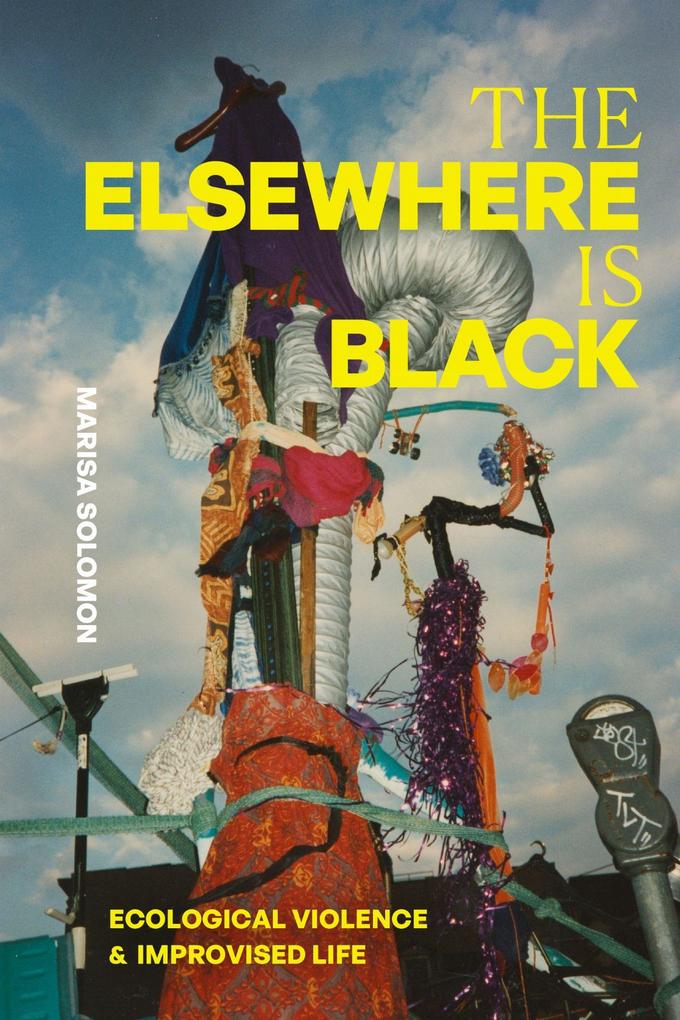
Tracing the flow of trash and waste from Brooklyn's poor Black neighborhood of Bedford-Stuyvesant to the post-plantation towns of Virginia's Tidewater, Marisa Solomon examines how waste is a mundane part of poor Black survival and a condition of racial capitalism.
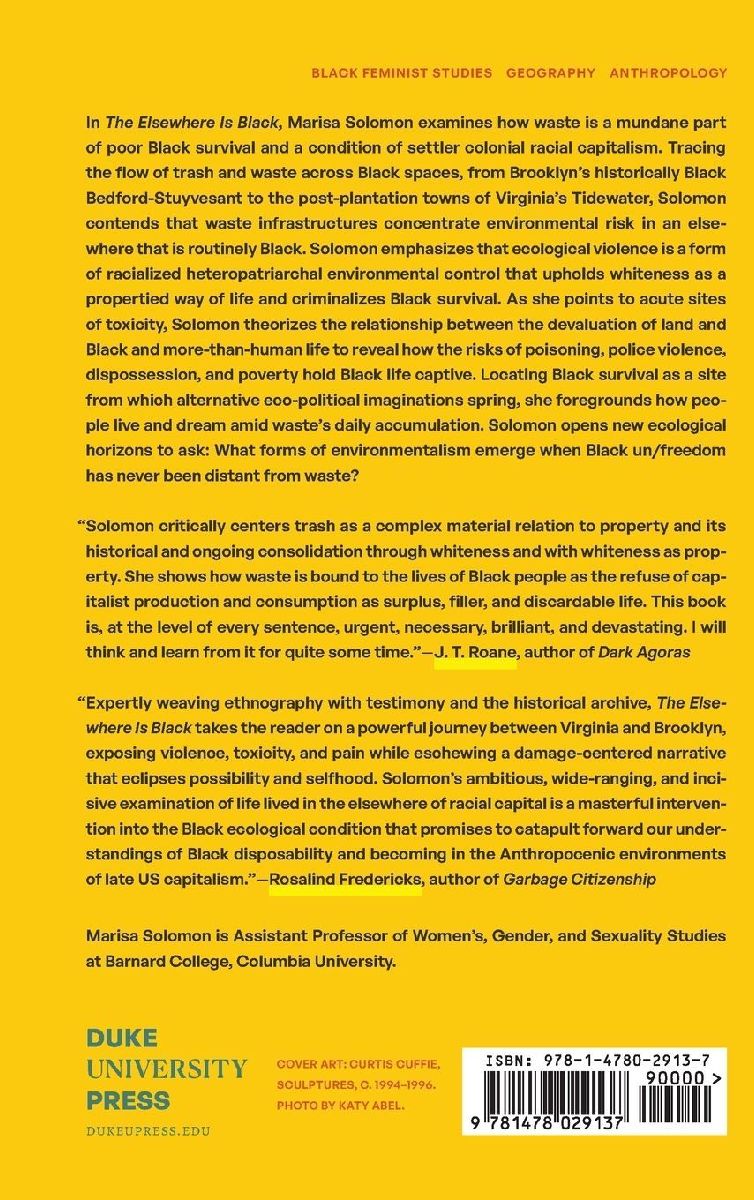
In The Elsewhere Is Black, Marisa Solomon examines how waste is a mundane part of poor Black survival and a condition of settler colonial racial capitalism. Tracing the flow of trash and waste across Black spaces, from Brooklyn's historically Black Bedford-Stuyvesant to the post-plantation towns of Virginia's Tidewater, Solomon contends that waste infrastructures concentrate environmental risk in an elsewhere that is routinely Black. Solomon emphasizes that ecological violence is a form of racialized heteropatriarchal environmental control that upholds whiteness as a propertied way of life and criminalizes Black survival. As she points to acute sites of toxicity, Solomon theorizes the relationship between the devaluation of land and Black and more-than-human life to reveal how the risks of poisoning, police violence, dispossession, and poverty hold Black life captive. Locating Black survival as site from which alternative eco-political imaginations spring, she foregrounds how people live and dream amidst waste's daily accumulation. Solomon opens new ecological horizons to ask: What forms of environmentalism emerge when Black un/freedom has never been distant from waste?
Duke University Press Scholars of Color First Book Award
Inhaltsverzeichnis
Acknowledgments ix< BR> Introduction: Introducing the Elsewhere 1< BR> Flow 24< BR> 1. Toxic Culture 30< BR> Infrastructure 59< BR> 2. Becoming Fill 65< BR> Surplus 92< BR> 3. Revisions from Elsewhere 98< BR> Disposal 133< BR> 4. Black Refractions 137< BR> Junk 155< BR> Conclusions: Fictions of Fabulous/Fabulative Ethnography 158< BR> Notes 179< BR> Bibliography 209< BR> Index 239