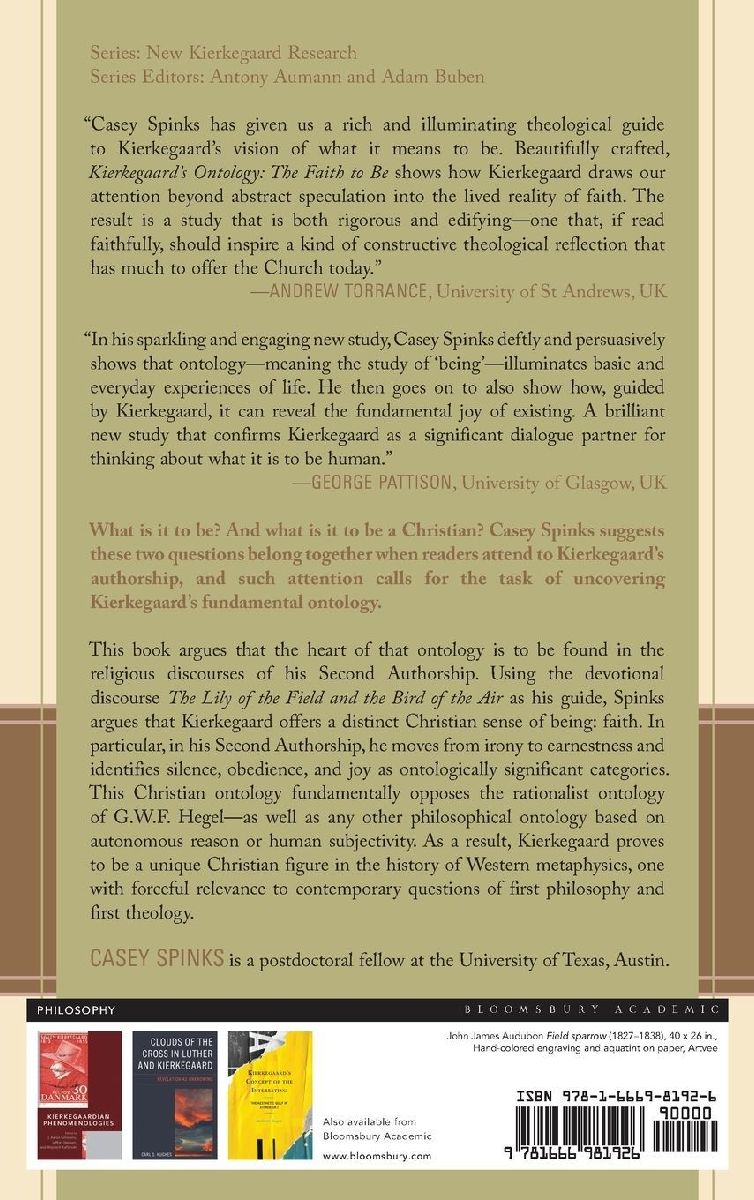
What is it to be? And what is it to be a Christian? Casey Spinks suggests these two questions belong together when readers attend to Kierkegaard's authorship, and such attention calls for the task of uncovering Kierkegaard's fundamental ontology.
This book argues that the heart of that ontology is to be found in the religious discourses of his Second Authorship. Using the devotional discourse The Lily of the Field and the Bird of the Air as his guide, Spinks argues that Kierkegaard offers a distinct Christian sense of being: faith. In particular, in his Second Authorship, he moves from irony to earnestness, and identifies silence, obedience, and joy as ontologically significant categories. This Christian ontology fundamentally opposes the rationalist ontology of G.W.F. Hegel-as well as any other philosophical ontology based on autonomous reason or human subjectivity. As a result, Kierkegaard proves to be a unique Christian figure in the history of Western metaphysics, one with forceful relevance to contemporary questions of first philosophy and first theology.
Inhaltsverzeichnis
Preface< BR> Acknowledgments< BR> A Note on Abbreviations< BR> Part One: Introduction< BR> Being and the Essentially Christian< BR> Part Two: Being an Ontological Writer< BR> Chapter Two: (Not) Being a Knower< BR> Chapter Three: Being Edified< BR> Part Three: Being-In-Itself: Silence< BR> Chapter Four: Being Silent< BR> Chapter Five: Against Being Bound to Human Speech< BR> Part Four: Being-For-Itself: Obedience< BR> Chapter Six: Being Obedient< BR> Chapter Seven: Against Being a Master< BR> Part Five: Being-In-And-For-Itself: Joy< BR> Chapter Eight: Being Joy< BR> Chapter Nine: Against Being in Despair< BR> Part Six: Conclusion< BR> The End of the Path of Thinking< BR> Bibliography< BR> Index