During the summer of 1990, while taking my holidays to teach a university course of physics for elementary teachers, I also tutored one of the tenth-grade students at my school in physics, chemistry, and mathematics. In return for working with him for free, I had requested permission to audiotape our sessions; I wanted to use the transcripts as data sources for a chapter that I had been in vited to write. It so happened that I discovered and read Jean Lave's Cognition in Practice that very summer, which inspired me to read other books on mathe matics in everyday situations. Two years later, while conducting a study with my teacher colleague G. Michael Bowen on eighth-grade students' learning during an open-inquiry ecology unit, I discovered these students' tremendous data analysis skills that appeared to be a function of the deep familiarity with the objects and events that they had studied and mathematized earlier in the unit. I reported my findings in two articles, 'Mathematization of experience in a grade 8 open-inquiry environment: An introduction to the representational practices of science' and 'Where is the context in contextual word problems? : Mathematical practices and products in Grade 8 students' answers to story problems'. I Begin ning with that study, I developed a research agenda that focused on mathemati cal knowing in science and science-related professions. During the early 1990s, I was also interested in the notion of authentic practice as a metaphor for planning school science curriculum.
Inhaltsverzeichnis
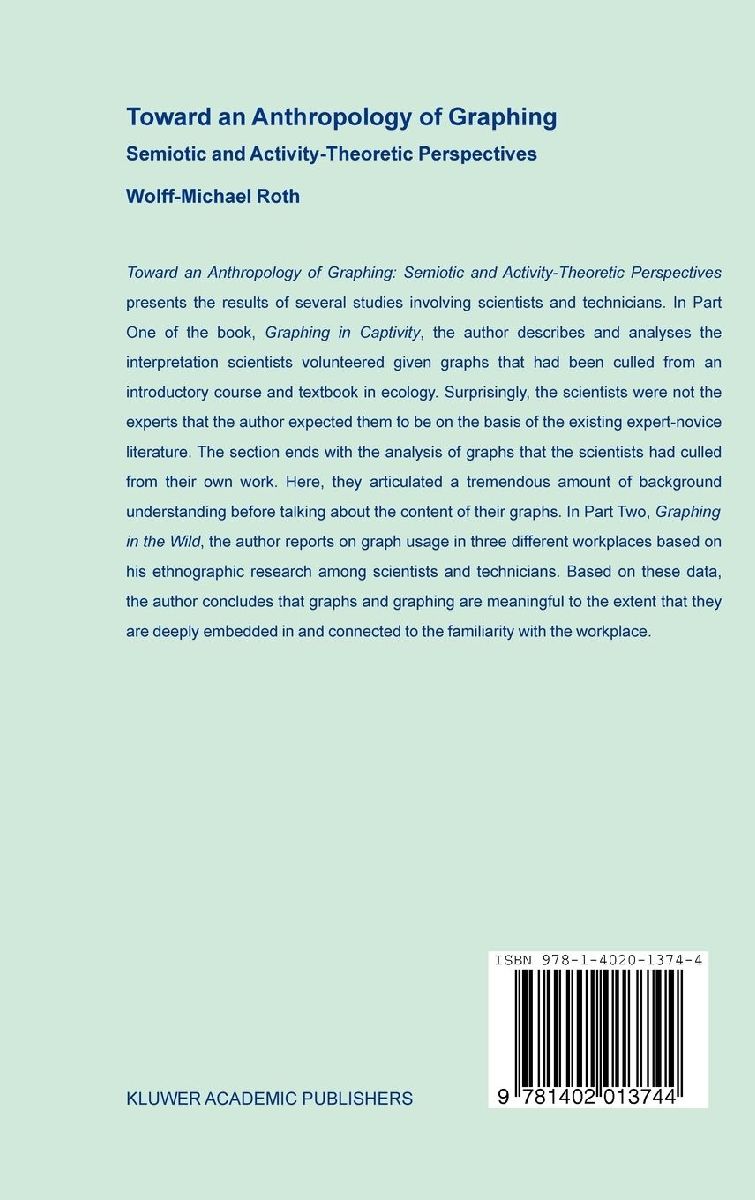
1 Toward an Anthropology of Graphing: An Introduction. - 1. 1 Graphing is Pervasive. - 1. 2 Nature of Practice. - 1. 3 Reading Graphs as Semiotic Practice. - 1. 4 Graphs as Sign Objects. - 1. 5 Graphing as Rhetorical Practice. - 1. 6 Graphs as Conscription Devices. - 1. 7 Conclusion and Outlook. - One: Graphing in Captivity. - 2 From `Expertise to Situated Reason: The Role of Experience, Familiarity, and Usefulness. - 3 Unfolding Interpretations: Graph Interpretation as Abduction. - 4 Problematic Readings: Case Studies of Scientists Struggling with Graph Interpretation. - 5 Articulating Background: Scientists Explain Graphs of their Own Making. - Two: Graphing in the Wild. - 6 Reading Graphs: Transparent Use of Graphs in Everyday Activity. - 7 From Writhing Lizards to Graphs: The Development of Embodied Graphing Competence. - 8 Fusion of Sign and Referent: From Interpreting to Reading of Graphs. - Appendix: The Tasks. - A. 1 Plant Distributions. - A. 2 Population Dynamics. - A. 3 Isoclines. - A. 4 Scientists Graphs. - Notes. - References.