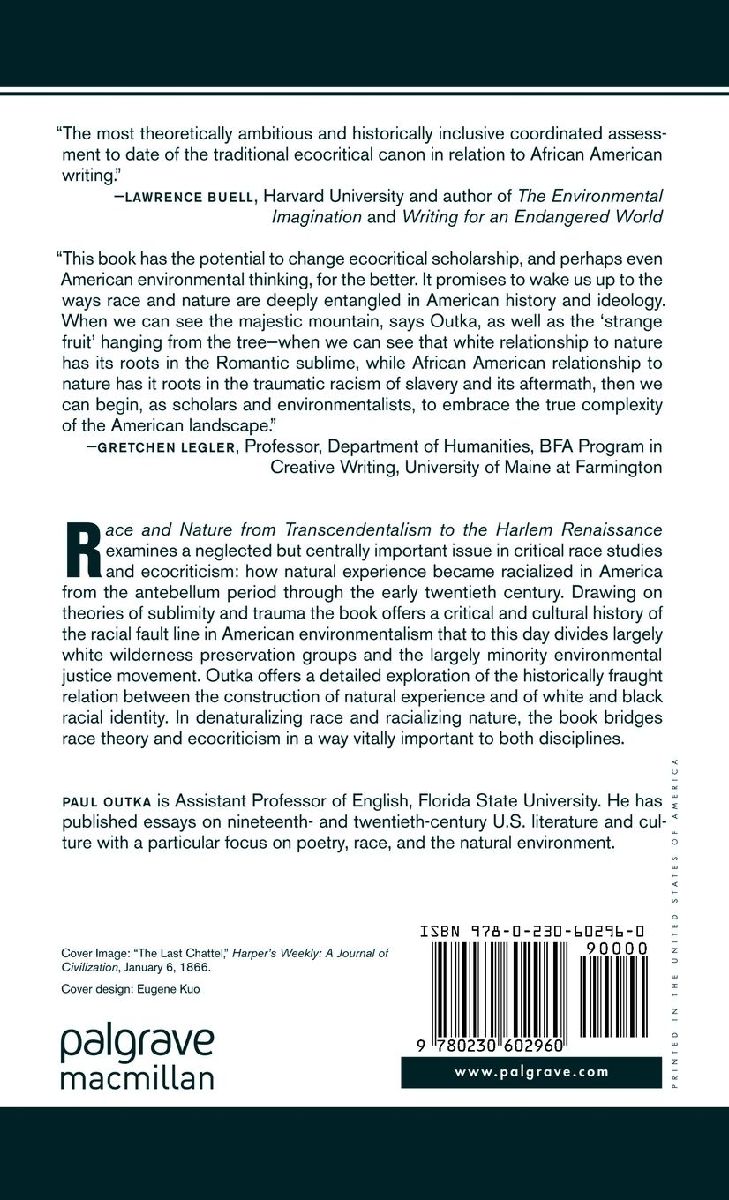
**2009 Biennial Prize for Ecocriticism from ASLE** "At each stopping point, the book sparkles with fascinating insights. Outka's reading of Angelina Weld Grimke's short stories from the Harlem Renaissance--with their chilling rejection of the sublime--is brilliant. His discussion of slave narratives, in turn, is powerfully provocative."--"Journal of American Ethnic History" "In an especially insightful argument...Outka's book sets a new precedent for important work to be done in articulating ecocriticism with African-America literature and other related fields."--"Journal of Ecocriticism" "Exciting, often brillant readings...Outka has made a major contribution to the fields of ecocriticism and race studies, revealing much of their mutual interest."--"Interdisciplinary Studies in Literature and Environment" "A very important book. It will significantly advance the discussion of environmental justice. I strongly recommend it."--James H. Cone, Charles Augustus Briggs Distinguished Professor of Systematic Theology, Union Theological Seminary "The most theoretically ambitious and historically inclusive coordinated assessment to date of the traditional ecocritical canon in relation to African-American writing."--Lawrence Buell, Harvard University and author of "The Environmental Imagination and Writing for an Endangered World" "This book has the potential to change ecocritical scholarship, and perhaps even American environmental thinking, for the better. It promises to wake us up to the ways race and nature are deeply entangled in American history and ideology. When we can see the majestic mountain, says Outka, as well as the 'strange fruit' hanging from the tree--when we can see that white relationship to nature has its roots in the Romantic sublime, while African American relationship to nature has it roots in the traumatic racism of slavery and its aftermath, then we can begin, as scholars and environmentalists, to embrace the true complexity of the American land