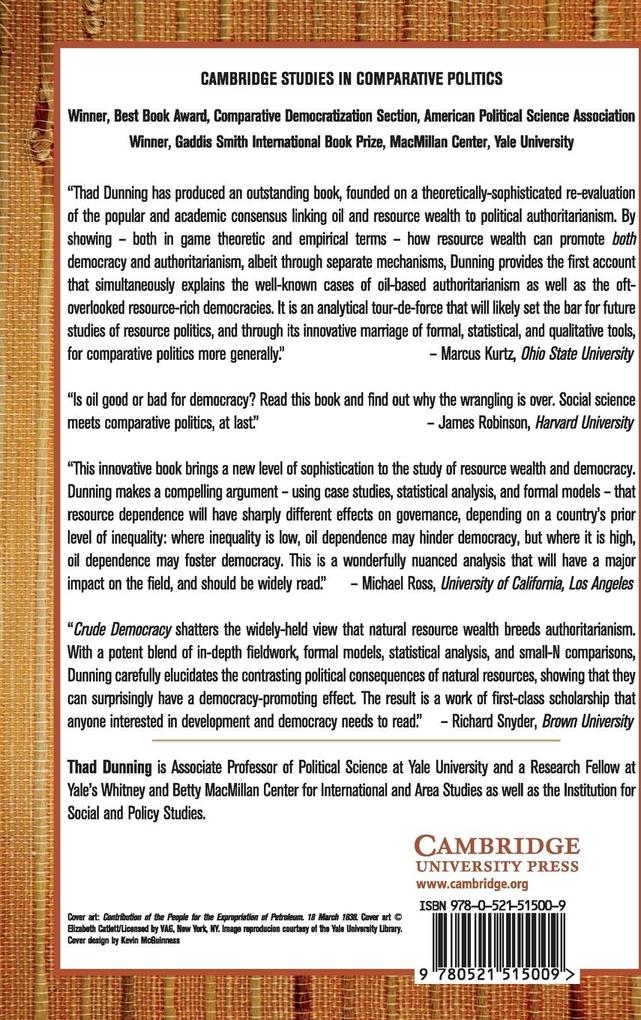
"Thad Dunning has produced an outstanding book, founded on a theoretically-sophisticated re-evaluation of the popular and academic consensus linking oil and resource wealth to political authoritarianism. By showing - both in game theoretic and empirical terms - how resource wealth can promote both democracy and authoritarianism, albeit through separate mechanisms, Dunning provides the first account that simultaneously explains the well-known cases of oil-based authoritarianism as well as the oft-overlooked resource-rich democracies. It is an analytical tour-de-force that will likely set the bar for future studies of resource politics, and through its innovative marriage of formal, statistical, and qualitative tools, for comparative politics more generally." -Marcus Kurtz, Ohio State University "Is oil good or bad for democracy? Read this book and find out why the wrangling is over. Social science meets comparative politics, at last." -James Robinson, Harvard University "This innovative book brings a new level of sophistication to the study of resource wealth and democracy. Dunning makes a compelling argument - using case studies, statistical analysis, and formal models - that resource dependence will have sharply different effects on governance, depending on a country's prior level of inequality: where inequality is low, oil dependence may hinder democracy, but where it is high, oil dependence may foster democracy. This is a wonderfully nuanced analysis that will have a major impact on the field, and should be widely read." -Michael Ross, University of California, Los Angeles "Crude Democracy shatters the widely-held view that natural resource wealth breeds authoritarianism. With a potent blend of in-depth fieldwork, formal models, statistical analysis, and small-N comparisons, Dunning carefully elucidates the contrasting political consequences of natural resources, showing that they can surprisingly have a democracy-promoting effect. The result is a work of first-class scholarship that anyone interested in development and democracy needs to read." -Richard Snyder, Brown University