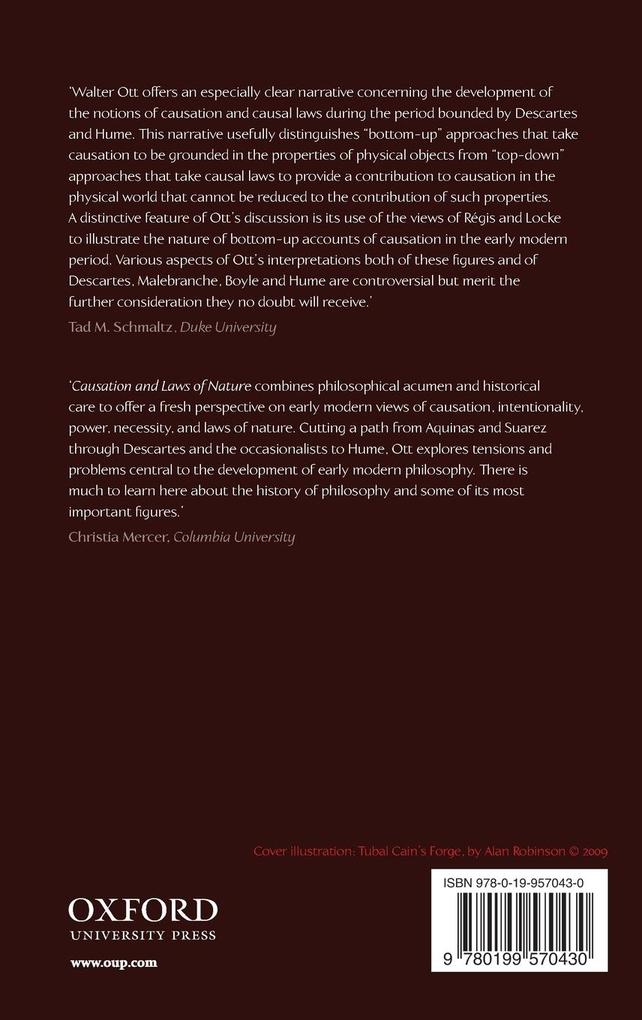
Walter Ott offers us a fascinating account of the development of theories of causation and laws of nature in the early modern period... a great piece of scholarship covering an impressive array of figures. It is quite a demanding read, but well worth the effort. Eric Stencil, Journal of the History of Philosophy I find the book truly illuminating, rich and intriguing. It is clearly an important contribution to the literature on early modern metaphysics and natural philosophy. Yitzhak Melamed, Archiv fuer Geschichte der Philosophie Causation and Laws of Nature combines philosophical acumen and historical care to offer a fresh perspective on early modern views of causation, intentionality, power, necessity, and laws of nature. Cutting a path from Aquinas and Suarez through Descartes and the occasionalists to Hume, Ott explores tensions and problems central to the development of early modern philosophy. There is much to learn here about the history of philosophy and some of its most important figures. Christia Mercer, Columbia University Walter Ott offers an especially clear narrative concerning the development of the notions of causation and causal laws during the period bounded by Descartes and Hume. This narrative usefully distinguishes bottom-up approaches that take causation to be grounded in the properties of physical objects from top-down approaches that take causal laws to provide a contribution to causation in the physical world that cannot be reduced to the contribution of such properties. A distinctive feature of Otts discussion is its use of the views of Regis and Locke to illustrate the nature of bottom-up accounts of causation in the early modern period. Various aspects of Otts interpretations both of these figures and of Descartes, Malebranche, Boyle and Hume are controversial but merit the further consideration they no doubt will receive. Tad M. Schmaltz, Duke University