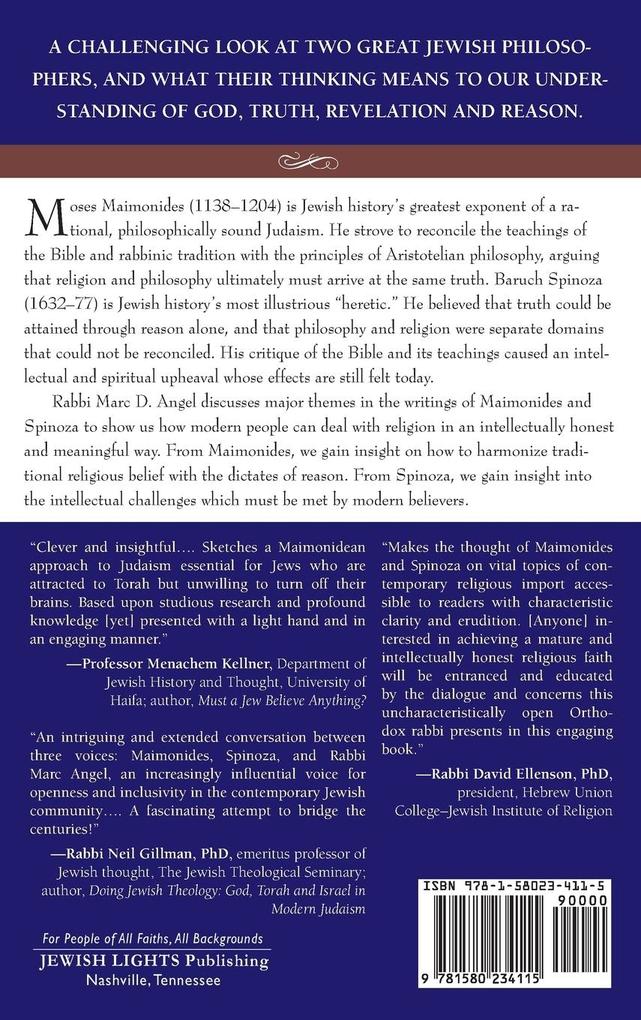
A challenging look at two great Jewish philosophers, and what their thinking means to our understanding of God, truth, revelation and reason.
Moses Maimonides (1138-1204) is Jewish history's greatest exponent of a rational, philosophically sound Judaism. He strove to reconcile the teachings of the Bible and rabbinic tradition with the principles of Aristotelian philosophy, arguing that religion and philosophy ultimately must arrive at the same truth.
Baruch Spinoza (1632-77) is Jewish history's most illustrious "heretic." He believed that truth could be attained through reason alone, and that philosophy and religion were separate domains that could not be reconciled. His critique of the Bible and its teachings caused an intellectual and spiritual upheaval whose effects are still felt today.
Rabbi Marc D. Angel discusses major themes in the writings of Maimonides and Spinoza to show us how modern people can deal with religion in an intellectually honest and meaningful way. From Maimonides, we gain insight on how to harmonize traditional religious belief with the dictates of reason. From Spinoza, we gain insight into the intellectual challenges which must be met by modern believers.
Inhaltsverzeichnis
Acknowledgments
Preface
1 Faith in Reason, Reason in Faith
2 The Nature of God, the God of Nature
3 Torah from Heaven
4 Divine Providence
5 The Oral Torah and Rabbinic Tradition
6 Religion and Superstition
7 Israel and Humanity
8 Conversion to Judaism
9 Eternal Torah, Changing Times
10 Faith and Reason
Notes
Suggestions for Further Reading