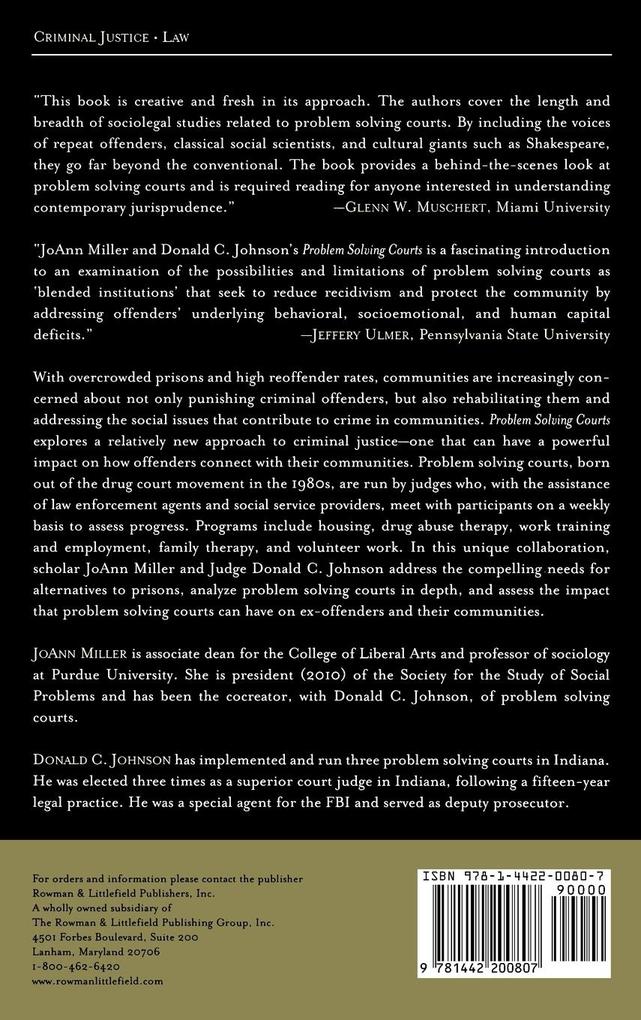
Problem Solving Courts examines a relatively new approach to criminal justice in which judges, advised by law enforcement officers and mental health workers, meet with offenders on a weekly basis to talk about their issues in a socio-legal setting where therapeutic intervention is combined with a measure of punishment for program violations. Sociologist JoAnn Miller and judge Donald C. Johnson, creators of three successful problem solving courts themselves, address the compelling needs for alternatives to prisons, analyze problem solving courts in depth, and assess the impact problem solving courts can have on offenders and their communities.
Inhaltsverzeichnis
Acknowledgments< BR> Introduction< BR> Part I: Setting the Stage< BR> Chapter 1: Measured Justice and Problem Solving Court Principles< BR> Chapter 2: The Purposes, Promises, and the Magic of Contemporary Criminal Law and Criminal Justice in the United States< BR> Chapter 3: A Problem Solving Court Jurisprudence< BR> Chapter 4: Timeless Problems, Innovative Solutions< BR> Part II: Courts, Prisons, and Communities< BR> Chapter 5: Responding to Reality: They all Come Home< BR> Chapter 6: Blended Social Institutions< BR> Chapter 7: The Community: What it Needs and What it Deserves< BR> Chapter 8: Words, Words, Words: Distinctions and Differences< BR> Part III: Performances and Transformations< BR> Chapter 9: Transforming Master Status< BR> Chapter 10: Backstage Action< BR> Chapter 11: Front-Stage Performances< BR> Chapter 12: Finale< BR> Appendix A Biographical Sketches< BR> Appendix B Reentry Court Participation Agreement< BR> Appendix C Waiver Forms< BR> Appendix D Reentry Court Participant's Handbook< BR> Notes< BR> References< BR> Index< BR> About the Authors