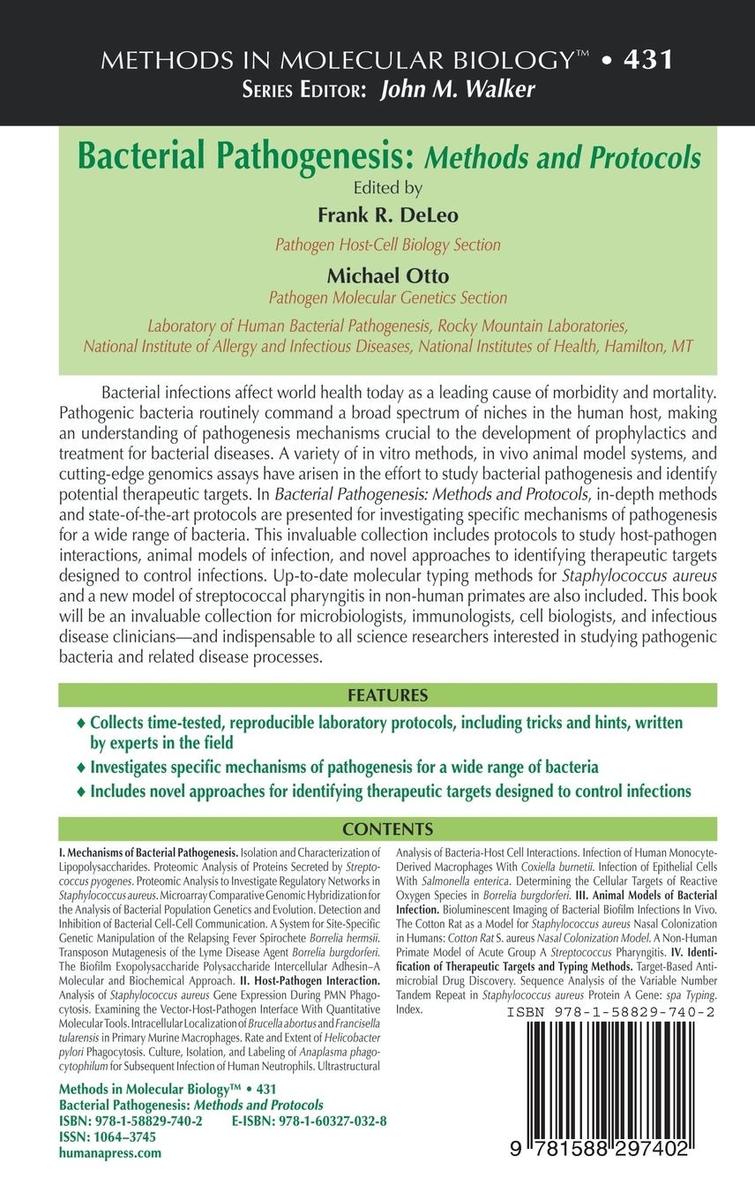
Bacterial infections affect world health today as a leading cause of morbidity and mortality. Pathogenic bacteria routinely command a broad spectrum of niches in the human host, making an understanding of pathogenesis mechanisms crucial to the development of prophylactics and treatment for bacterial diseases. A variety of in vitro methods, in vivo animal model systems and cutting-edge genomics assays have arisen in the effort to study bacterial pathogenesis and identify potential therapeutic targets. In Bacterial Pathogenesis, in-depth methods and state-of-the-art protocols are presented for investigating specific mechanisms of pathogenesis for a wide range of bacteria. This invaluable collection includes protocols to study host-pathogen interactions, animal models of infection, and novel approaches to identifying therapeutic targets designed to control infections. Up-to-date molecular typing methods for Staphylococcus aureus and a new model of streptococcal pharyngitis in non-human primates are also included. Bacterial Pathogenesis will prove an invaluable collection for microbiologists, immunologists, cell biologists and infectious disease clinicians - and indispensable to all science researchers interested in studying pathogenic bacteria and related disease processes.
Inhaltsverzeichnis
Preface. - Contributors. - List of Color Plates. - I: Mechanisms of Bacterial Pathogenesis. - 1 Isolation and Characterization of LipopolysaccharidesMichael A. Apicella. - 2 Proteomic Analysis of Proteins Secreted by Streptococcus pyogenesMichelle A. Chaussee, Emily J. McDowell, and Michael S. Chaussee. - 3 Proteomic Analysis to Investigate Regulatory Networks in Staphylococcus aureusSusanne Engelmann and Michael Hecker. - 4 Microarray Comparative Genomic Hybridization for the Analysis of Bacterial Population Genetics and EvolutionCaitriona M. Guinane and J. Ross Fitzgerald. - 5 Detection and Inhibition of Bacterial Cell Cell CommunicationScott A. Rice, Diane McDougald, Michael Givskov, and Staffan Kjelleberg. - 6 A System for Site-Specific Genetic Manipulation of the Relapsing Fever Spirochete Borrelia hermsiiJames M. Battisti, Sandra J. Raffel, and Tom G. Schwan. - 7 Transposon Mutagenesis of the Lyme Disease Agent Borrelia burgdorferiPhilip E. Stewart and Patricia A. Rosa. - 8 The Biofilm Exopolysaccharide Polysaccharide Intercellular Adhesin? A Molecular and Biochemical ApproachCuong Vuong and Michael Otto. - II: Host-Pathogen Interaction. - 9 Analysis of Staphylococcus aureus Gene Expression During PMN PhagocytosisJovanka M. Voyich, Dan E. Sturdevant, and Frank R. DeLeo. - 10 Examining the Vector Host Pathogen Interface With Quantitative Molecular ToolsJason E. Comer, Ellen A. Lorange, and B. Joseph Hinnebusch. - 11 Intracellular Localization of Brucella abortus and Francisella tularensis in Primary Murine MacrophagesJean Celli. - 12 Rate and Extent of Helicobacter pylori PhagocytosisLee-Ann H. Allen. - 13 Culture, Isolation, and Labeling of Anaplasma phagocytophilum for Subsequent Infection of Human NeutrophilsDori L. Borjesson. - 14 Ultrastructural Analysis ofBacteria Host Cell InteractionsDavid W. Dorward. - 15 Infection of Human Monocyte-Derived Macrophages With Coxiella burnetiiJeffrey G. Shannon and Robert A. Heinzen. - 16 Infection of Epithelial Cells With Salmonella entericaOlivia Steele-Mortimer. - 17 Determining the Cellular Targets of Reactive Oxygen Species in Borrelia burgdorferiJulie A. Boylan and Frank C. Gherardini. - III: Animal Models of Bacterial Infection. - 18 Bioluminescent Imaging of Bacterial Biofilm Infections In VivoJagath L. Kadurugamuwa and Kevin P. Francis. - 19 The Cotton Rat as a Model for Staphylococcus aureus Nasal Colonization in Humans: Cotton Rat S. aureus Nasal Colonization ModelJohn F. Kokai-Kun. - 20 A Non-Human Primate Model of Acute Group A Streptococcus PharyngitisPaul Sumby, Anne H. Tart, and James M. Musser. - IV: Identification of Therapeutic Targets and Typing Methods. - 21 Target-Based Antimicrobial Drug DiscoveryLefa E. Alksne and Paul M. Dunman. - 21 Sequence Analysis of the Variable Number Tandem Repeat in Staphylococcus aureus Protein A Gene: spa TypingBarun Mathema, Jose Mediavilla, and Barry N. Kreiswirth.