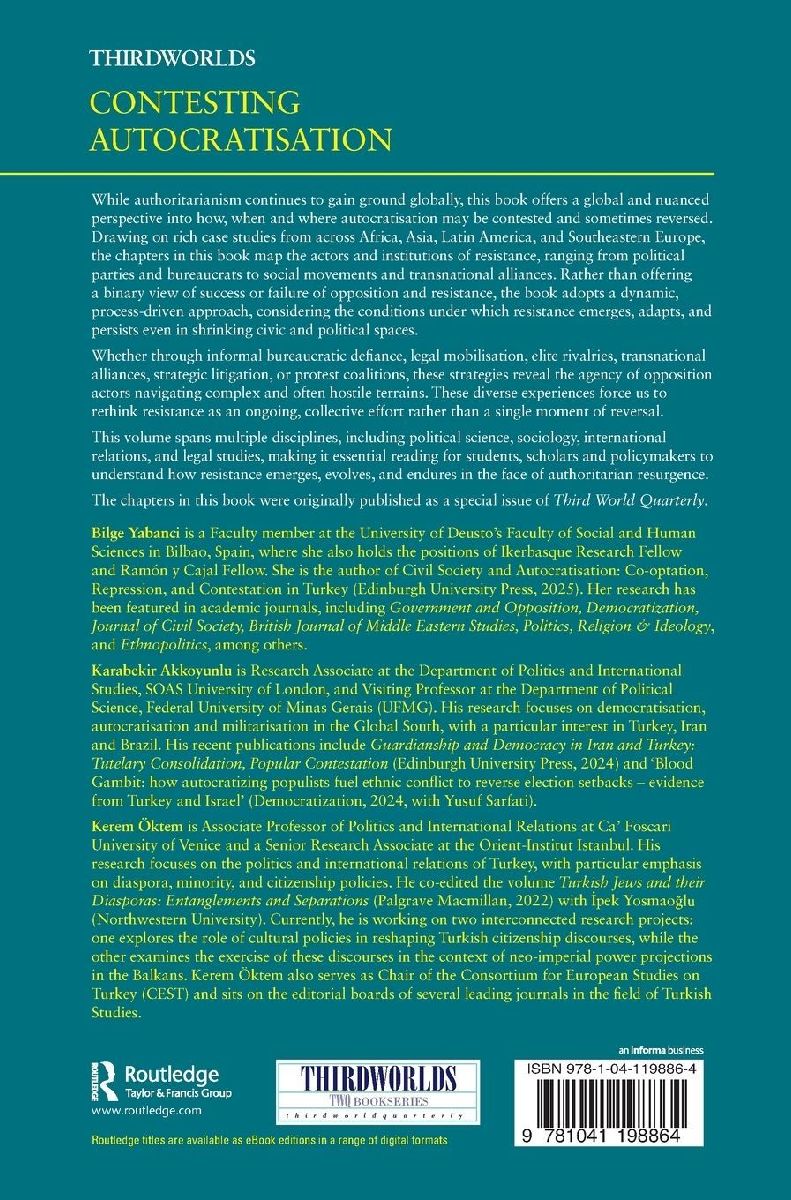
Drawing on rich case studies from across Africa, Asia, Latin America, and Southeastern Europe, the chapters in this book map the actors and institutions of resistance, ranging from political parties and bureaucrats to social movements and transnational alliances.
Inhaltsverzeichnis
Introduction: Contesting autocratisation: actors and institutions of democratic resistance in a global perspective 1. Paperwork as statecraft: documents, politics, and bureaucratic agency in street-level organisations 2. Legalised resistance to autocratisation in common law Africa 3. The limits of autocratisation in Indonesia: power dispersal and elite competition in a compromised democracy 4. Resistance under confinement: resilience of protests and their limits in authoritarian Turkey 5. Protests for change: mass protests against competitive authoritarian regimes in the Western Balkans 6. Safeguarding democracy from the outside in: transnational democratic networks against autocratisation in contemporary Brazil 7. Formal yet ineffective opposition coordination under competitive authoritarianism: Nation Alliance in Turkey 8. The role of the opposition in autocratisation: the case of Turkey 9. What role do social accountability actors play in resisting media capture in sub-Saharan Africa? Evidence from Ghana 10. Social movements against Hindutva: analysing their impact on the Indian state's support for cow protection vigilantism