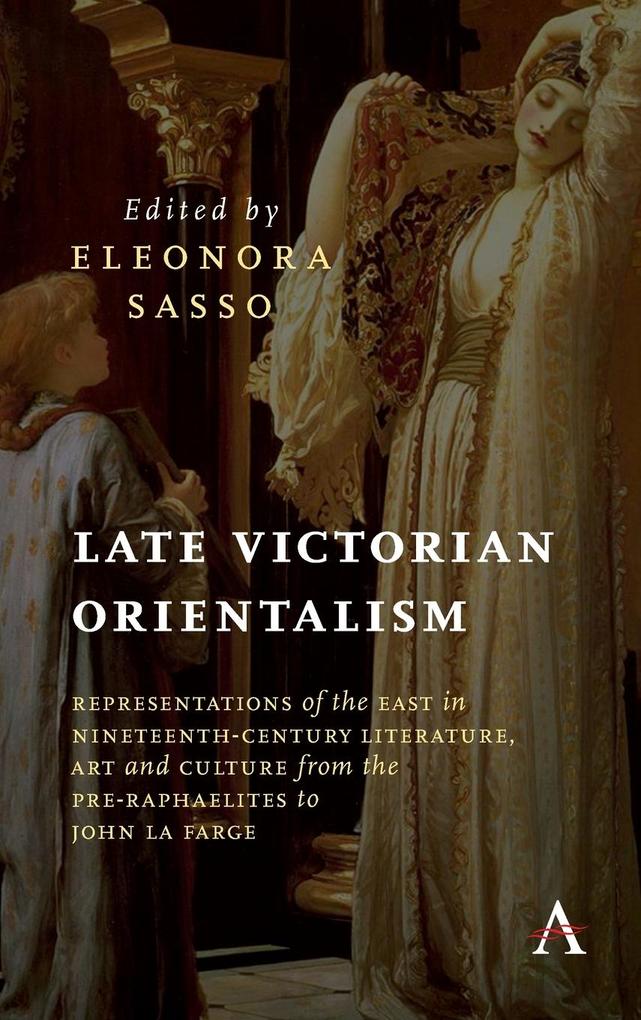
Late Victorian Orientalism is a work of scholarly research pushing forward disciplines into new areas of enquiry. This collection of essays tries to redefine the task of interpreting the East in the nineteenth century taking as a starting point Edward Said's Orientalism (1978) in order to investigate the visual, fantasised, and imperialist representations of the East as well as the most exemplary translations of Oriental texts. The Victorians envisioned the East in many different modes or Orientalisms since as Said suggested '[t]here were, perhaps, as many Orientalisms as Orientalists'. By combining together Western and Oriental modes of art, this study is not only aimed at filling a gap in Victorian and Oriental studies but also at broadening the audiences it is intended for.
Inhaltsverzeichnis
Introduction; Chapter I, Robert Douglas-Fairhurst, 'FitzGerald's Timelines'; Chapter II, Florence Boos, 'Empires and Scapegoats: The Pre-Raphaelites in the Near East'; Chapter III, Eleonora Sasso, 'aja'ib, mutalibun, and hur al-ayan: Rossetti, Morris, Swinburne and the Arabian Nights'; Chapter IV, Andrea Mariani, 'The Use of Contradictions in John La Farge's Prismatic Syncretism'; Chapter V, Elisa Bizzotto, ' "Strange webs with Eastern merchants": The Orient of Aesthetic Poetry'; Chapter VI, Miriam Sette, 'Rudyard Kipling, The Mark of the Beast and the Elusive Monkey'; Chapter VII, Christopher Ainslie Cowell, 'Borrowed Verses: Code and Representation Within the First Travelogue of the City of Hong Kong, 1841-2'; Chapter VIII, Ben Cocking, 'Newby and Thesiger: Humour and Lament in the Hindu Kush'; Chapter IX, Fabrizio Impellizzeri, 'The Exoticism of Téchiné's Les Sœurs Brontë: The Dream of an Impossible Elsewhere'; Bibliography; Index.