Bücher versandkostenfrei*100 Tage Rückgaberecht***Abholung in über 100 Filialen
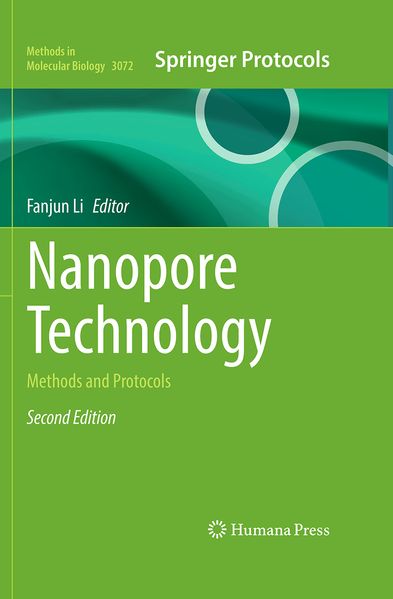
This second edition explores new and updated methods and techniques on nanopore sensing. Chapters guide readers through protein nanopores, various solid-state nanopores, and the use of technique droplet interface bilayer in nanopore sensing and membrane biophysical studies. Written for the highly successful Methods in Molecular Biology series, chapters include introductions to their respective topics, lists of the necessary materials and reagents, step-by-step, readily reproducible laboratory protocols, and tips on troubleshooting and avoiding known pitfalls.
Authoritative and practical, Nanopore Technology: Methods and Protocols, Second Edition aims to empower researchers to build their own platforms, move past the technical hurdles of fabrication, and focus on the most vital part of the process: discovery.
Inhaltsverzeichnis
Purification and Oligomerization of YaxAB Nanopores. - Expression and Purification of CytK Nanopores. - Tuning rectification and gating in biological nanopores through lumen charge mutation. - Protein analyte sensing with an Outer membrane protein G (OmpG) nanopore. - A selective activity-based approach for analysis of enzymes with an OmpG nanopore. - Engineering a Monomeric Nanopore Scaffold for Multiplexed Protein Detection. - A cyclodextrin-mediated host-guest interactions within -hemolysin nanopore platform for PFAS identification. - Optical and Electrical Characterization of Nanopores in Freestanding Lipid Bilayers. - Simulation of pH-Dependent, Loop-Based Membrane Protein Gating Using Pretzel. - Fabrication and Characterization of Glass Nanopores. - Preparation and Detection of Designed DNA Carriers for Nanopore Sensing. - Preparing fixed DNA carriers for movable-nanopore (SICS) experiments. - Polymer Translocation through a Nanopore. - Yhreading of Single Protein Molecules Through a Solid-State Nanopor. - eMetrology of nanoscale objects using nanopores. - Protein Transport Studied by a Model Asymmetric Membrane Army Arranged in a Dimple Chip. - Droplet contact method for stable and reproducible lipid bilayer formation and its application to nanopore measurements.
Es wurden noch keine Bewertungen abgegeben. Schreiben Sie die erste Bewertung zu "Nanopore Technology" und helfen Sie damit anderen bei der Kaufentscheidung.