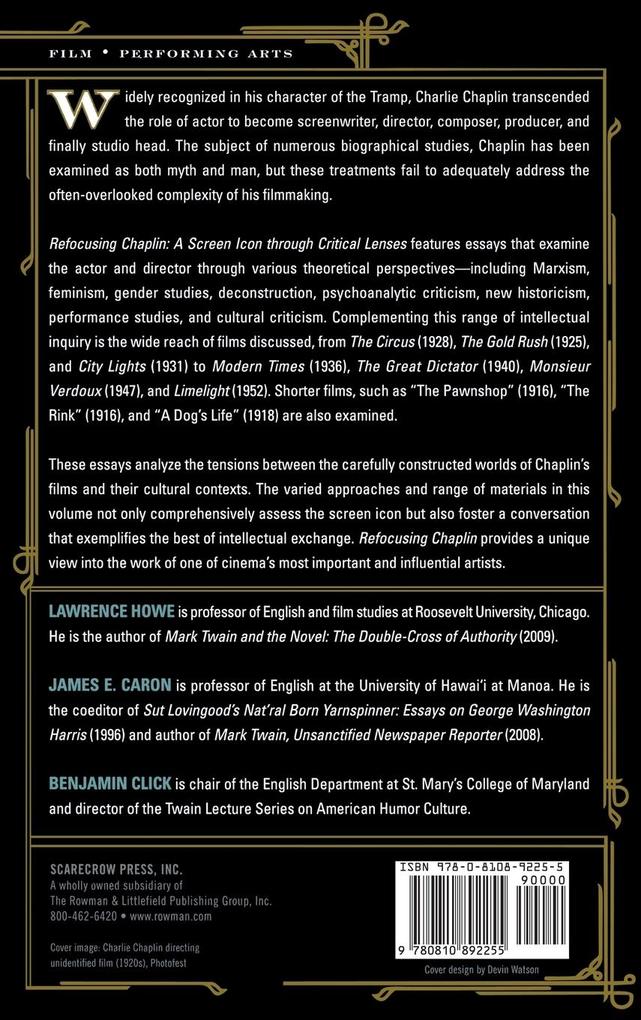
This is a collection of scholarly essays that focuses on particular phases of Chaplin’s career through various critical lenses, in order to highlight the understated, and often overlooked, complexity of Chaplin’s filmmaking, and to provide insight into both the extensive range and the limits of the critical leverage of a broad array of interpretive theories.
Inhaltsverzeichnis
Preface: Why Refocus Chaplin?
Lawrence Howe, James E. Caron, and Benjamin Click
Acknowledgements
Introduction: The Persisting Appeal of Chaplin and Charlie
Charles Maland
Chapter 1: Chaplin's "Charlie" as Merleau-Ponty's Phenomenological Everyman or, How Bodily Intelligence Manifests the Personae, Styles, and Fable of Slapstick
James E. Caron
Chapter 2: Chaplin and the Static Image: A Barthesian Analysis of the Visual in My Trip Abroad and "A Comedian Sees the World"
Lisa Stein Haven
Chapter 3: A Heart of Gold: Charlie and the Dance Hall Girls
Cynthia J. Miller
Chapter 4: American Masculinity and The Gendered Humor of Chaplin's Little Tramp
Lawrence Howe
Chapter 5: In the Shadow of Machines: Modern Times and the Iconography of Technology
A. Bowdoin Van Riper
Chapter 6: Deconstruction and the Tramp: Marxism, Capitalism, and the Trace
Randall Gann
Chapter 7: Chaplin's Presence
Rachel Joseph
Chapter 8: The Paradox of the "Dictactor": Mimesis, Logic of Paradox, and the Reinstatement of Catharsis in The Great Dictator, Monsieur Verdoux, and Limelight
Marco Grosoli
Chapter 9: Charles Chaplin Sings a Silent Requiem: Chaplin's Films from 1928-1952 as Cinematic Statement on the Transition from Silent Cinema to the Talkies
Aner Preminger
Chapter 10: Chaplin's Sound Statement on Silence: The Great Dictator as Rhetorical Encomium
Benjamin Click
Bibliography
Index
About the Contributors
About the Editors