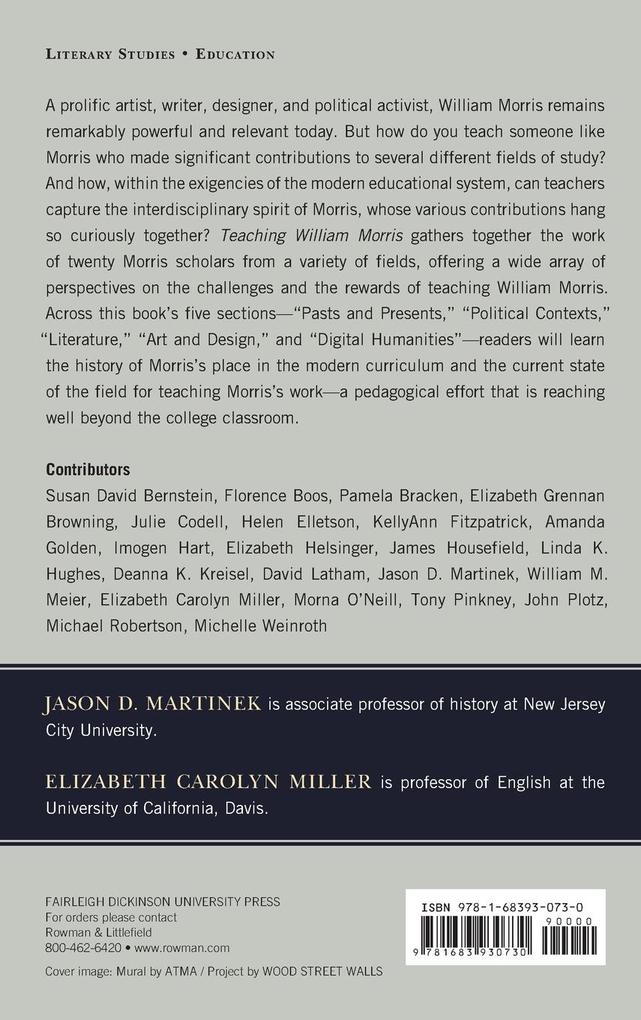
Long before the word "interdisciplinary" entered the landscape of higher education, William Morris embodied that ideal. Teaching William Morris offers a wide array of perspectives on the challenges and the rewards of teaching this Victorian polymath whose ideas and creations remain so powerful today.
Inhaltsverzeichnis
Acknowledgments< BR> Introduction: "The Earthly Paradox": Teaching William Morris< BR> Jason D. Martinek and Elizabeth Carolyn Miller< BR> < BR> Part I: Pasts and Presents< BR> 1. "Teaching Morris in Chicago, c. 1900"< BR> Elizabeth Helsinger< BR> 2. "Naturalizing the Dignity of Labor: The Hull-House Labor Museum and William Morris's Influence on the American Settlement House Movement"< BR> Elizabeth Grennan Browning< BR> 3. "Time Travelling with William Morris"< BR> John Plotz< BR> 4. "'Work and Fun' and 'Education at its Finest:' Teaching Morris at Kelmscott House,"< BR> Helen Elleston< BR> 5. "The Medievalism of William Morris: Teaching Through Tolkien" < BR> KellyAnn Fitzpatrick< BR> < BR> Part II: Political Contexts< BR> 6. "A Dream of William Cobbett? Teaching Morris's John Ball in an Interdisciplinary Course on Victorian Radicalism"< BR> Linda Hughes and William M. Meier< BR> 7. "'Vive La Commune!' The Imaginary of the Paris Commune and the Arts and Crafts Movement"< BR> Morna O'Neill< BR> 8. "'Living in Heaven': Hope and Change in News from Nowhere"< BR> David Latham< BR> < BR> Part III: Literat