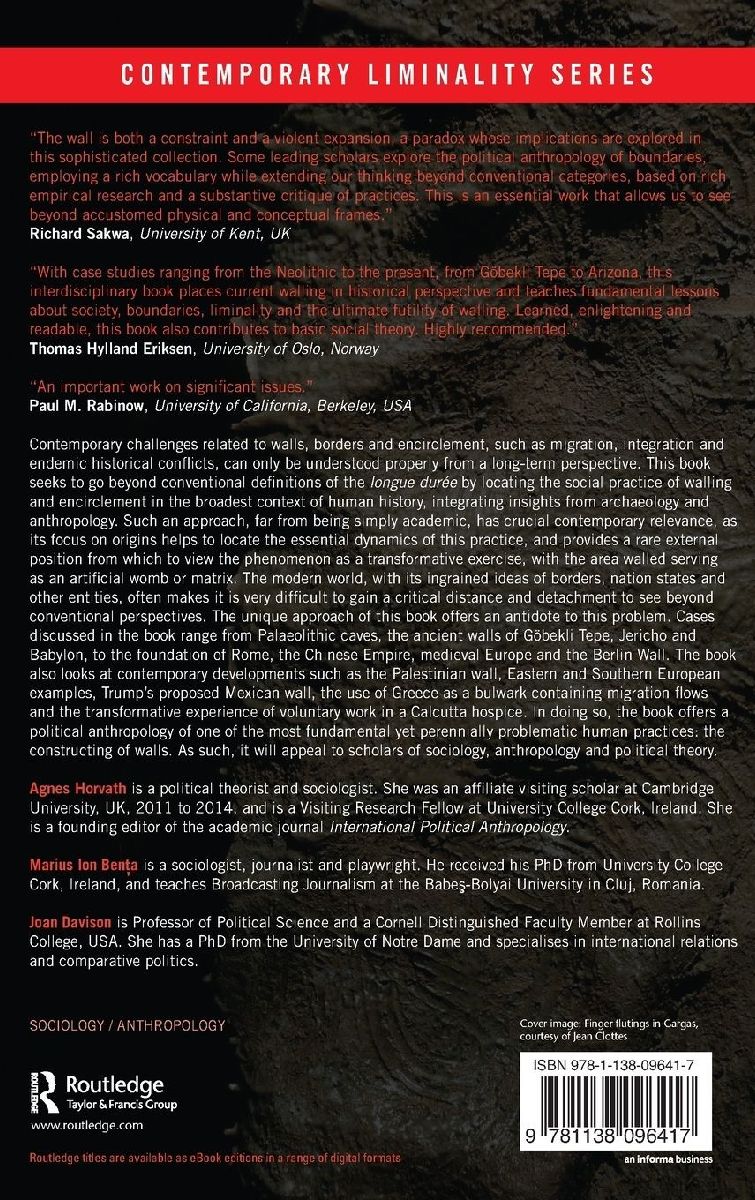
Going beyond conventional definitions of 'the long term', this book locates the social practice of walling and encirclement in the broadest context of human history, integrating insights from archaeology and anthropology. It locates the essential dynamics of the practice, showing how walling produces a paranoid vision of the world in which whatever falls outside the wall becomes demonised and threatening, and stands in need of ever-renewed attempts to exterminate it. A study of the isolating practice of walling, Walling, Boundaries and Liminality explores the links between the kind of dangerous expansion that walling represents, and its accompanying loss of certainty and inner conviction.
Inhaltsverzeichnis
List of figures; Notes on contributors; Preface; Introduction: on the political anthropology of walling (Agnes Horvath, Marius Ion Ben a and Joan Davison); Part I: Theorising walling: processes of transformation in history; 1. Walling Europe: the perverted linear transformation (Agnes Horvath); 2. The meaning and meaninglessness of building walls (Arpad Szakolczai); 3. Oppressive walling: Babel and the inverted order of the world (Marius Ion Ben a); Part II Contemporary examples for transformations through walling; 4. Walling as encystation: a socio-historical inquiry (Glenn Bowman); 5. Border-crossing and walling states in humanitarian work in Kolkata (Egor Novikov); 6. Liminality and belonging: the life and the afterlives of the Berlin Wall (Harald Wydra); 7.The Great Wall of China does not exist (Erik Ringmar); 8. Breaching Fortress Europe: the liminal consequences of the Greek migrant crisis (Manussos Marangudakis); 9. Imaginary walls and the paradox of strength (Arvydas Grišinas); 10. Identities frozen, societies betrayed, communities divided: the US-Mexican Wall (Joan Davison); Conclusion (Agnes Horvath, Marius Ion Ben a and Joan Davison); Index