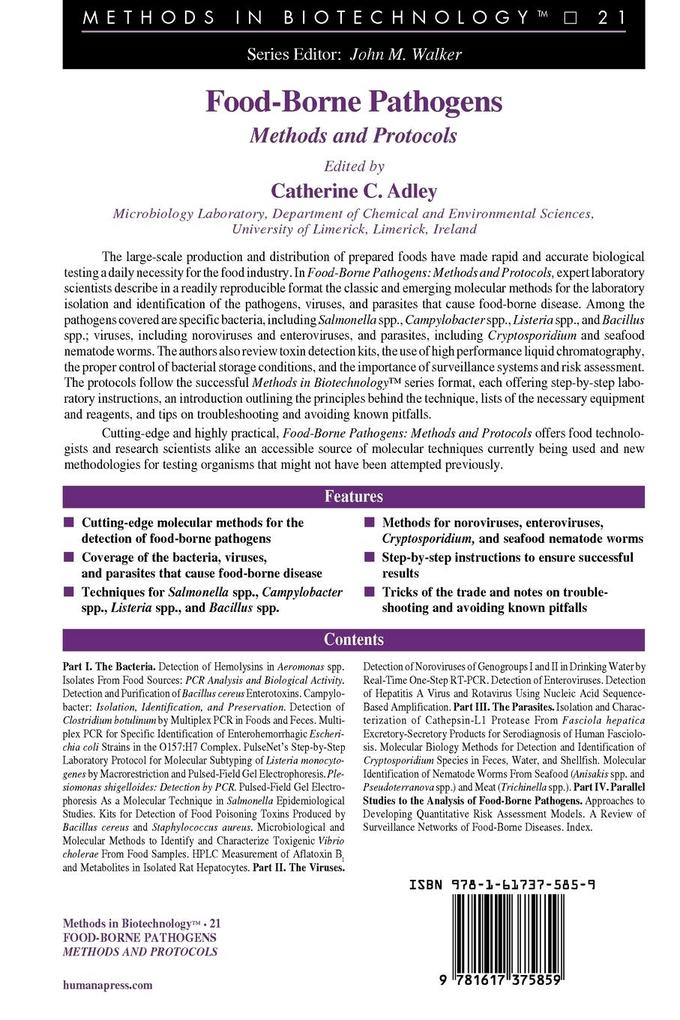
A collection of readily reproducible classic and emerging molecular methods for the laboratory isolation and identification of the pathogens, viruses, and parasites that cause food-borne disease. Among the pathogens covered are specific bacteria, including Salmonella spp, Campylobacter spp. , Listeria spp. , and Bacillus spp. ; viruses, including noroviruses and enteroviruses; and parasites, including Cryptosporidium and seafood nematode worms. The protocols follow the successful Methods in Biotechnology(TM) series format, each offering step-by-step laboratory instructions, an introduction outlining the principles behind the technique, lists of the necessary equipment and reagents, and tips on troubleshooting and avoiding known pitfalls.
Inhaltsverzeichnis
The Bacteria. - Detection of Hemolysins in Aeromonas spp. Isolates From Food Sources. - Detection and Purification of Bacillus cereus Enterotoxins. - Campylobacter. - Detection of Clostridium botulinum by Multiplex PCR in Foods and Feces. - Multiplex PCR for Specific Identification of Enterohemorrhagic Escherichia coli Strains in the O157:H7 Complex. - PulseNet s Step-by-Step Laboratory Protocol for Molecular Subtyping of Listeria monocytogenes by Macrorestriction and Pulsed-Field Gel Electrophoresis. - Plesiomonas shigelloides. - Pulsed-Field Gel Electrophoresis As a Molecular Technique in Salmonella Epidemiological Studies. - Kits for Detection of Food Poisoning Toxins Produced by Bacillus cereus and Staphylococcus aureus. - Microbiological and Molecular Methods to Identify and Characterize Toxigenic Vibrio cholerae From Food Samples. - HPLC Measurement of Aflatoxin B1 and Metabolites in Isolated Rat Hepatocytes. - The Viruses. - Detection of Noroviruses of Genogroups I and II in Drinking Water by Real-Time One-Step RT-PCR. - Detection of Enteroviruses. - Detection of Hepatitis A Virus and Rotavirus Using Nucleic Acid Sequence-Based Amplification. - The Parasites. - Isolation and Characterization of Cathepsin-L1 Protease From Fasciola hepatica Excretory-Secretory Products for Serodiagnosis of Human Fasciolosis. - Molecular Biology Methods for Detection and Identification of Cryptosporidium Species in Feces, Water, and Shellfish. - Molecular Identification of Nematode Worms From Seafood (Anisakis spp. and Pseudoterranova spp.) and Meat (Trichinella spp.). - Parallel Studies to the Analysis of Food-Borne Pathogens. - Approaches to Developing Quantitative Risk Assessment Models. - A Review of Surveillance Networks of Food-Borne Diseases.