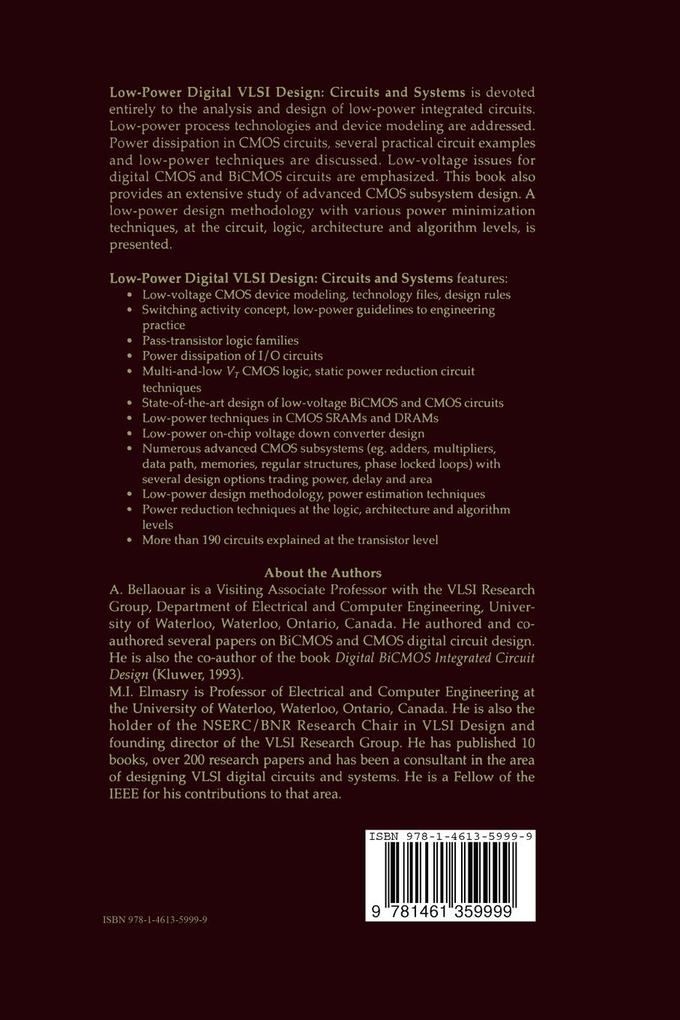
Low-Power Digital VLSI Design: Circuits and Systems addresses both process technologies and device modeling. Power dissipation in CMOS circuits, several practical circuit examples, and low-power techniques are discussed. Low-voltage issues for digital CMOS and BiCMOS circuits are emphasized. The book also provides an extensive study of advanced CMOS subsystem design. A low-power design methodology is presented with various power minimization techniques at the circuit, logic, architecture and algorithm levels.
Features:
- Low-voltage CMOS device modeling, technology files, design rules
- Switching activity concept, low-power guidelines to engineering practice
- Pass-transistor logic families
- Power dissipation of I/O circuits
- Multi- and low- V T CMOS logic, static power reduction circuit techniques
- State of the art design of low-voltage BiCMOS and CMOS circuits
- Low-power techniques in CMOS SRAMS and DRAMS
- Low-power on-chip voltage down converter design
- Numerous advanced CMOS subsystems (e. g. adders, multipliers, data path, memories, regular structures, phase-locked loops) with several design options trading power, delay and area
- Low-power design methodology, power estimation techniques
- Power reduction techniques at the logic, architecture and algorithm levels
- More than 190 circuits explained at the transistor level.
Inhaltsverzeichnis
1 Low-Power VLSI Design: An Overview. - 1. 1 Why Low-Power? . - 1. 2 Low-Power Applications. - 1. 3 Low-Power Design Methodology. - 1. 4 This Book. - References. - 2 Low-Voltage Process Technology. - 2. 1 CMOS Process Technology. - 2. 2 Bipolar Process Technology. - 2. 3 Isolation in CMOS and Bipolar Technologies. - 2. 4 CMOS and Bipolar Processes Convergence. - 2. 5 BiCMOS Technology. - 2. 6 Complementary BiCMOS Technology. - 2. 7 BiCMOS Design Rules. - 2. 8 Silicon On Insulator. - 2. 9 Chapter Summary. - References. - 3 Low-Voltage Device Modeling. - 3. 1 MOSFET Structure and Operation. - 3. 2 SPICE Models of the MOS Transistor. - 3. 3 CMOS Low-Voltage Analytical Model. - 3. 4 CMOS Power Supply Voltage Scaling. - 3. 5 Modeling of the Bipolar Transistor. - References. - 4 Low-Voltage Low-Power VLSI CMOS Circuit Design. - 4. 1 CMOS Inverter: DC Characteristics. - 4. 2 CMOS Inverter: Switching Characteristics. - 4. 3 Power Dissipation. - 4. 4 Capacitance Estimation. - 4. 5 CMOS static Logic Design. - 4. 6 CMOS Logic Styles. - 4. 7 Clocking. -4. 8 Pass-Transistor Logic Families. - 4. 9 I/O Circuits. - 4. 10 Low-Power Circuit Techniques. - 4. 11 Adiabatic Computing. - 4. 12 Chapter Summary. - References. - 5 Low-Voltage VLSI BiCMOS Circuit Design. - 5. 1 Conventional BiCMOS Logic. - 5. 2 BYNMOS Logic Family. - 5. 3 Low-Voltage BiCMOS families. - 5. 4 Low-Voltage BiCMOS Applications. - 5. 5 Chapter Summary. - References. - 6 Low-Power CMOS Random Access Memory Circuits. - 6. 1 Static RAM (SRAM). - 6. 2 Dynamic RAM. - 6. 3 On-Chip Voltage Down Converter. - 6. 4 Chapter Summary. - References. - 7 VLSI CMOS Subsystem Design. - 7. 1 Parallel Adders. - 7. 2 Parallel Multipliers. - 7. 3 Data Path. - 7. 4 Regular Structures. - 7. 5 Phase Locked Loops. - 7. 6 Chapter Summary. - References. - 8 Low-Power VLSI Design Methodology. - 8. 1 LP Physical Design. - 8. 2 LP Gate-Level Design. - 8. 3 LP Architecture-Level Design. - 8. 4 Algorithmic-Level Power Reduction. - 8. 5 Power Estimation Techniques. - 8. 6 Chapter Summary. - References. - Reference.