A challenging critique of Karl Barth's theology of the resurrection of the flesh, highlighting the problems in the idea of a participatory eschatology.
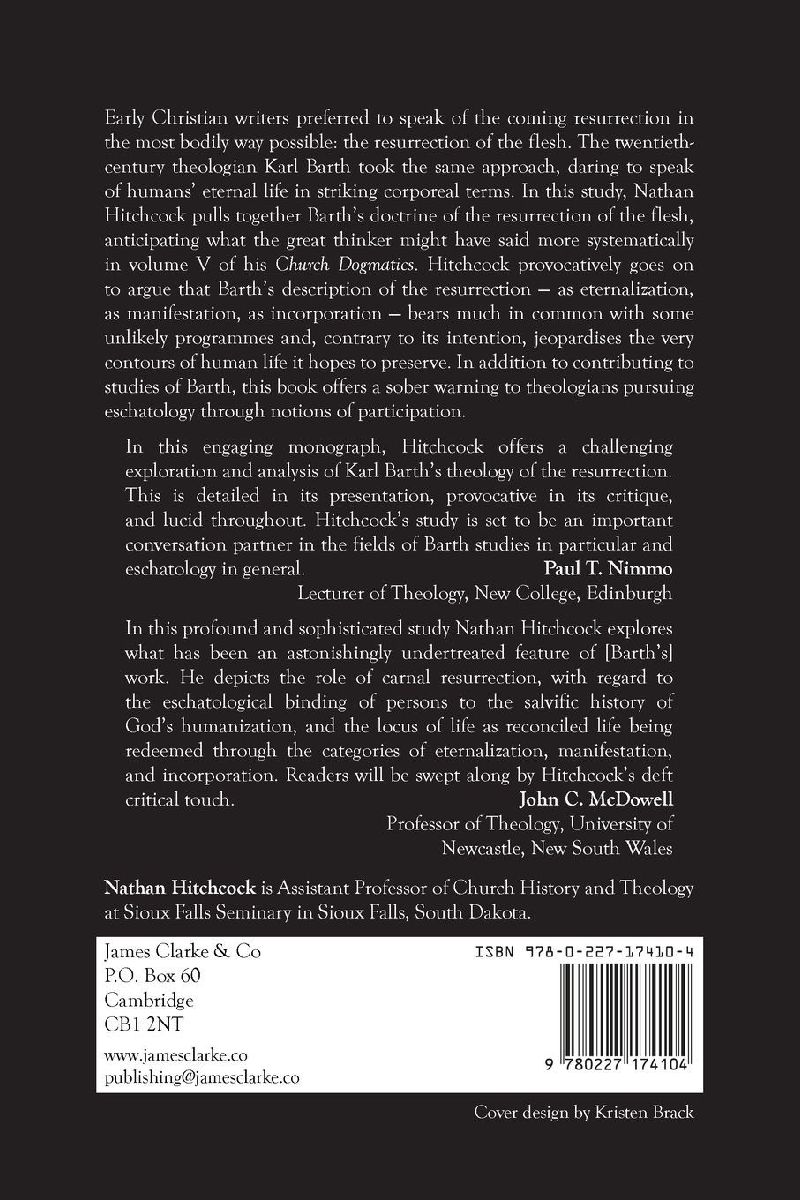
Early Christian writers preferred to speak of the coming resurrection in the most bodily way possible: the resurrection of the flesh. Twentieth-century theologian Karl Barth took the same avenue, daring to speak of humans' eternal life in rather striking corporeal terms. In this study, Nathan Hitchcock pulls together Barth's doctrine of the resurrection of the flesh, anticipating what the great thinker might have said more systematically in volume V of his 'Church Dogmatics'. Provocatively, Hitchcock goes on to argue that Barth's description of the resurrection - as eternalization, as manifestation, as incorporation - bears much in common with some unlikely programs and, contrary to its intention, jeopardizes the very contours of human life it hopes to preserve. In addition to contributing to Barth studies, this book offers a sober warning to theologians pursuing eschatology through notions of participation.
Inhaltsverzeichnis
Foreword by Philip G. Ziegler
Preface
Acknowledgements
Abbreviations
1 Redeeming the Flesh
2 Young Barth's Resurrection Dialectic
3 The Resurrection of the Flesh as Eternalization
4 The Resurrection of the Flesh as Manifestation
5 The Resurrection of the Flesh as Incorporation
6 A Future in the Flesh
Bibliography
Index