Ian Little offers a new defence of utilitarianism as a basis for assessing the role of the State. Lucidly and elegantly he explains how the three disciplines of philosophy, economics, and politics can be integrated to provide guidance on issues of public policy. Anyone interested in public affairs will be enlightened by Little's crisp analysis and any student taking an interdisciplinary course in social science will find a clear framework for thinking about the subject.
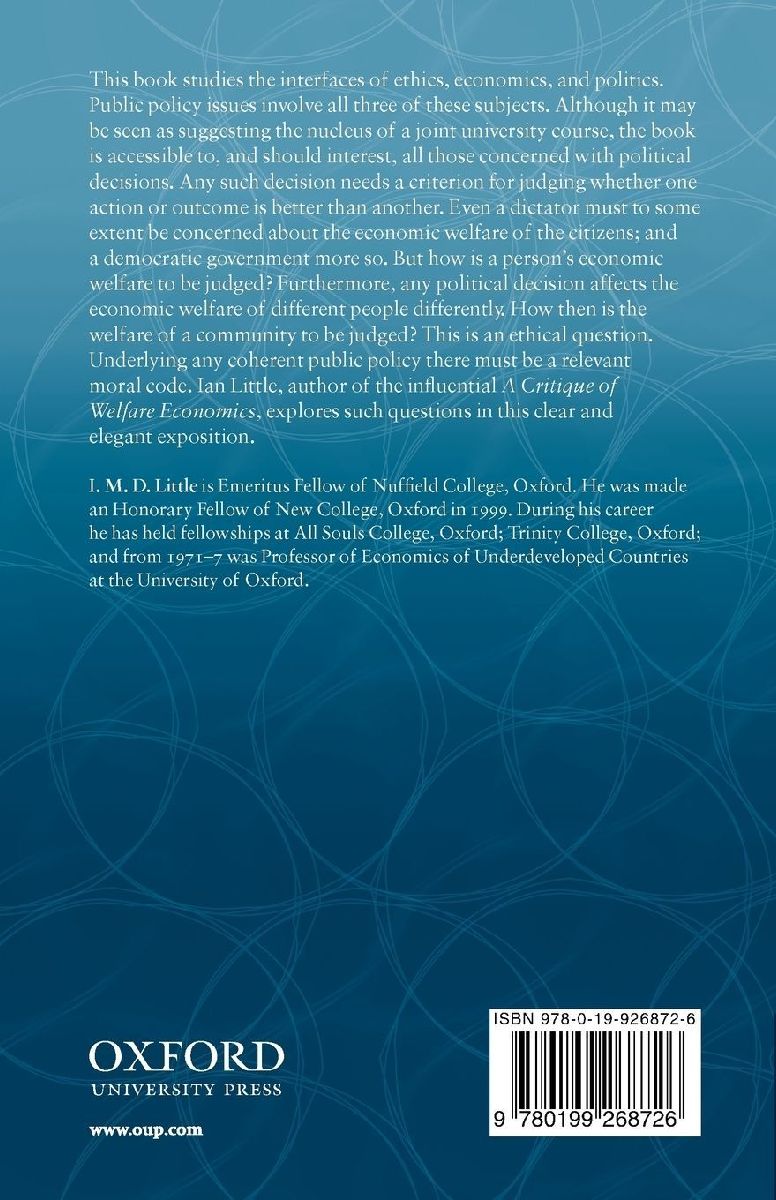
This book studies the interfaces of ethics, economics, and politics. Public policy issues involve all three of these subjects. Although it may be seen as suggesting the nucleus of a joint university course, the book is accessible to and should interest all those concerned with political decisions. Any such decision needs a criterion for judging whether one action or outcome is better than another. Even a dictator must to some extent be concerned about the economic welfare of the citizens; and a democratic government more so. But how is a person's economic welfare to be judged? Furthermore, any political decision affects the economic welfare of different people differently. How then is the welfare of a community to be judged? This is an ethical question. Underlying any coherent public policy there must be a relevant moral code.
Inhaltsverzeichnis
- Introduction
- Part I: Economics and Philosophy
- 1: Personal Utility and Welfare
- 2: Collective Utility and Welfare
- 3: Welfare Economics
- Part II: Politics and Philosophy
- 4: The Role of the State
- 5: Utilitarianism: Theory and Application
- 6: Utilitarianism: Justice and Equality
- 7: Contractarianism
- 8: Communitarianism
- Part III: Economics and Politics
- 9: Games, Conventions, and Public Goods
- 10: Positive Political Economy
- 11: Normative Political Economy
- Part IV: The Principles of Public Policy
- 12: The Principles of Public Policy