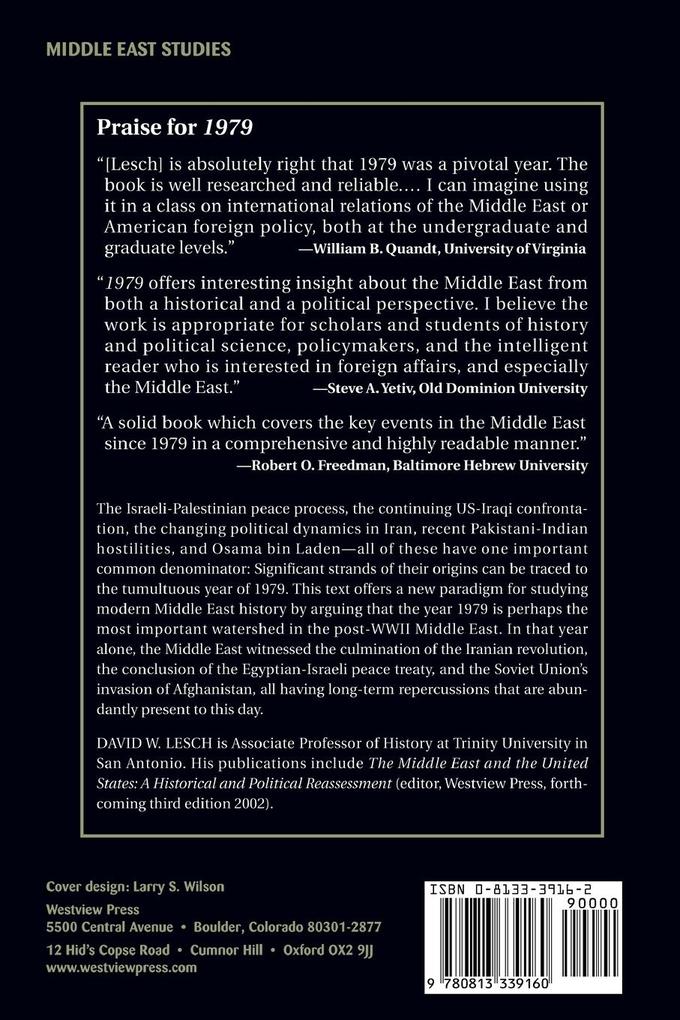
The Israeli-Palestinian peace process, the continuing US-Iraqi confrontation, the changing political dynamics in Iran, recent Pakistani-Indian hostilities, and Osama bin Laden -- all of these have one important common denominator: significant strands of their origins can be traced to the tumultuous year of 1979. This books offers a new paradigm for studying modern Middle East history by arguing that the year 1979 is perhaps the most important watershed in the post-WWII Middle East. In that year alone, the Middle East witnessed the culmination of the Iranian revolution, the conclusion of the Egyptian-Israeli peace treaty, and the Soviet Union's invasion of Afghanistan, all having long-term repercussions that are abundantly present to this day in Middle East society and politics, and in the relations between the Middle East and the United States.
Inhaltsverzeichnis
Preface, Introduction: The Secular Priesthood and "Annualization", The Events, Future Past, Conclusion, Appendix A: The Camp David Accords, Appendix 8: Peace Treaty between Egypt and Israel, Appendix C: Annual State of the Union Message (1980) (the Carter Doctrine), Notes, Bibliography, Index