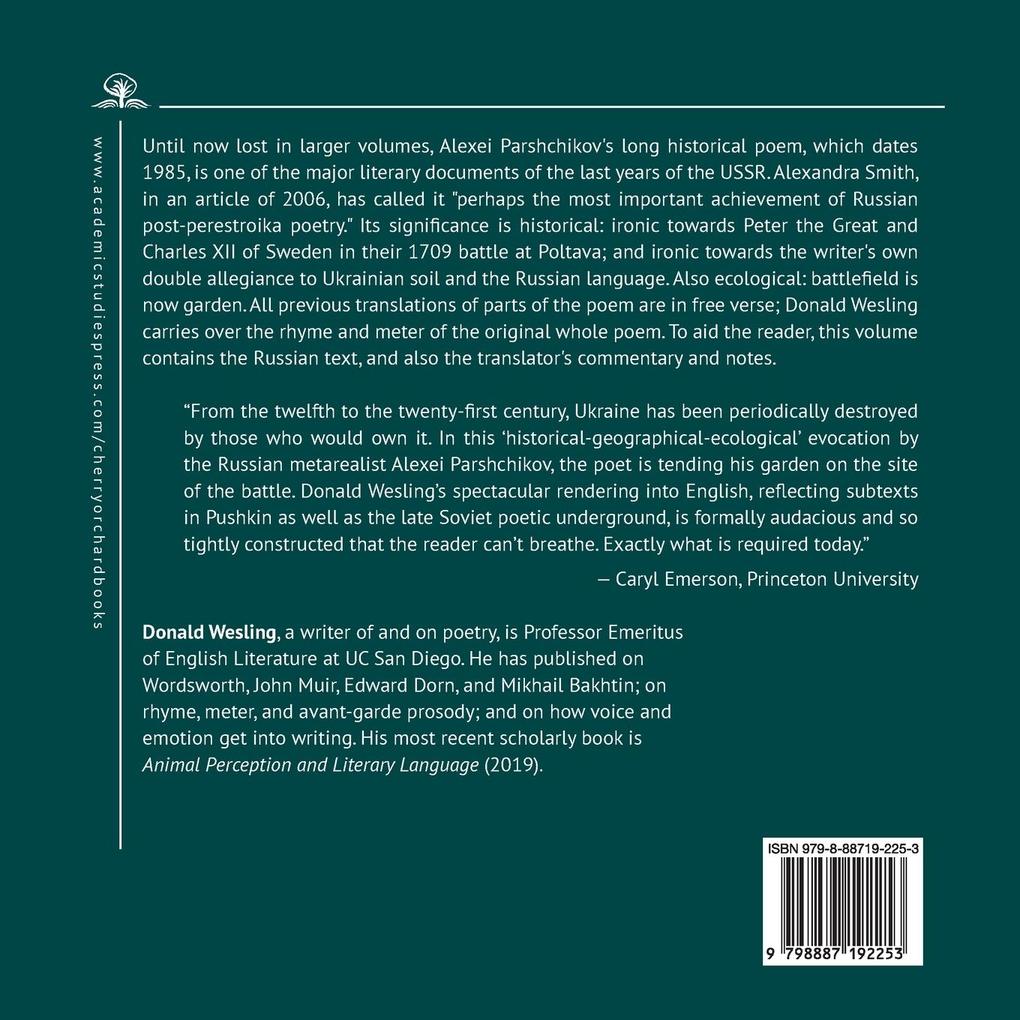
Longlisted for the 2024 PEN Award for Poetry in Translation, this prize-winning historical-lyrical poem of 1985, on the unequal power-relations between Russia and Ukraine, darkly resonates in 2023. Alexei Parshchikov's long historical poem, which dates 1985, is one of the major literary documents of the last years of the USSR. Alexandra Smith, in an article of 2006, has called it " perhaps the most important achievement of Russian post-perestroika poetry. " Its significance is historical in its irony towards Peter the Great and Charles XII of Sweden in their 1709 battle at Poltava and towards the writer's own dual allegiance to Ukrainian soil and the Russian language. While all previous translations of parts of the poem are in free verse, translator Donald Wesling here carries over the rhyme and meter of the original whole poem. To aid the reader, this volume contains the Russian text, and also the translator's commentary and notes.
Inhaltsverzeichnis
From the Translator
INTRODUCTION
CHAPTER ONE, WHICH TELLS ABOUT THE ORIGIN OF WEAPONS
1. 1. The Origin of Weapons
1. 2. The First Cannon
1. 3. The Lamb Tells about the Feud of Two Brothers, Who Attempted to Catch Him for Sacrifice, and about How a Knife was Born
1. 4. The First Business Retreat, Written in My Garden, Located on the Field of the Battle of Poltava
CHAPTER TWO: THE BATTLE
2. 1.
2. 2. Point of View of the Observer
2. 3. Charles XII
2. 4. Ivan Mazepa and Marfa Kochubey
2. 5. No Saxophone Slung over the Shoulder
2. 6. Mosquito
2. 7. Copper Framework: Second Business Retreat
CHAPTER THREE: THE TSAR REWARDS
Notes