Professor Bruce Scott spent his entire professional career at Harvard Business School, except for 5 years spent with an affiliated school in Switzerland. During that Swiss interval, in the 1960s, he researched the role of French national planning on its industrial sector. This research played a significant role in the subsequent decision by the French government to discontinue its indicative planning for industry. At the same time it also reoriented all his subsequent work to the study of economic governance and economic strategies of nations as contrasted with firms. The fruits of that new orientation were first published by Springer Verlag in 2009 as a monograph called
The Concept of Capitalism
, and subsequently in its entirety as a 700 page book, also by Springer, called
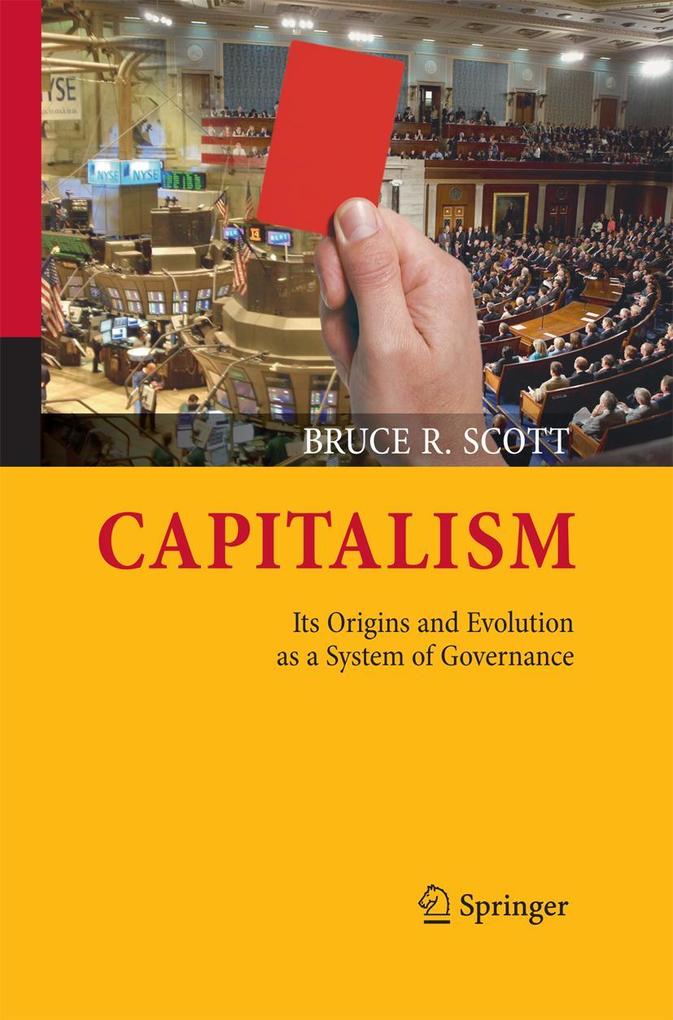
Capitalism, its Origins and Evolutionas a System of Governance
. Professor Scott made an abbreviated presentation of his ideas on the relationship between capitalism and democracy in the nation building process in the Libyan context at a TEDX meeting in Tripoli in February, 2012, a presentation which was attended by the Deputy Prime Minister and a number of cabinet members and which was taped for reuse by the TED organization.
Professor Scott is scheduled to teach a full semester course called
Capitalism as a System of Governance
at Harvard Extension School beginning in January 2013 (http://www. extension. harvard. edu/courses/capitalism-system-governance) . A full description of the course is available through the Extension School, including day by day reading assignments and suggested study questions. The course is built around readings from two primary sources;
Capitalism,
by Professor Scott, and
Why Nations Fail
, by Daron Acemoglu and James Robinson (published by Crown Business). The basic thesis of the course is that capitalism has emerged only where limited monarchy and the rule of law have already prevailed, and thus with generallyinclusive and therefore egalitarian institutions. Thus capitalism seems to date to Venice circa 1200. The basically complementary thesis of Acemoglu and Robinson is that extractive institutions and oppressive governance have characterized the failures. Acemoglu and Robinson argue that the first notable example of inclusive and relatively egalitarian institutions dates to England and its glorious revolution of 1688-89, which paved the way for the industrial revolution and economic progress. Capitalism is not featured in their account.