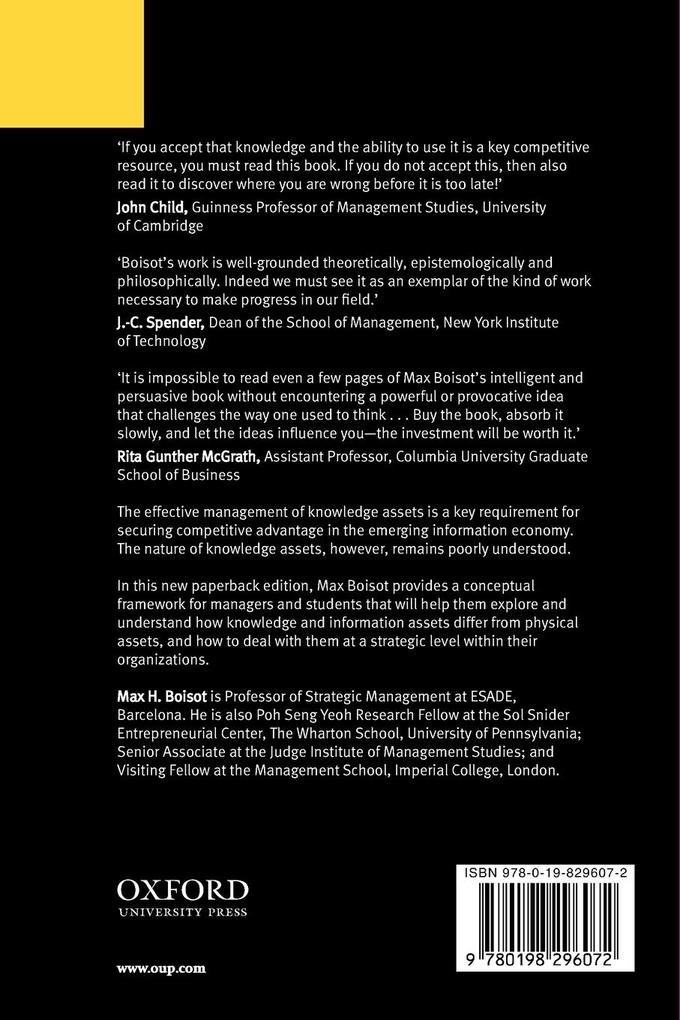
The effective management of knowledge assets is a key requirement for securing competitive advantage in the emerging information economy. The nature of knowledge assets, however, remains poorly understood. In this new paperback edition, Max Boisot provides a conceptual framework for managers and students that will help them explore and understand how knowledge and information assets differ from physical assets, and how to deal with them at a strategic level within their organizations.
It is now widely recognized that the effective management of knowledge assets is a key requirement for securing competitive advantage in the emerging information economy. Yet the physical and institutional differences between tangible assets and knowledge assets remains poorly understood. This clear, accessible study provides some of the key building blocks needed for a theory of knowledge assets. Boisot develops a powerful conceptual framework -- the Information-Space or I-Space -- for exploring the way knowledge flows within and between organizations. This framework wilt enable managers and students to explore and understand how knowledge and information assets differ from physical assets, and how to deal with them at a strategic level within their organizations.
Inhaltsverzeichnis
- 1: Introduction
- 2: The Information Perspective
- 3: I-Space: The Information Space
- 4: The Paradox of Value
- 5: Neoclassical versus Schumpeterian Orientation to Learning
- 6: Culture as a Knowledge Asset
- 7: Products, Technologies, and Organizations in the Social Learning Cycle
- 8: Competence and Intent
- 9: IT and its Impact
- 10: Applying the I-Space
- 11: Recapitulation and Conclusion