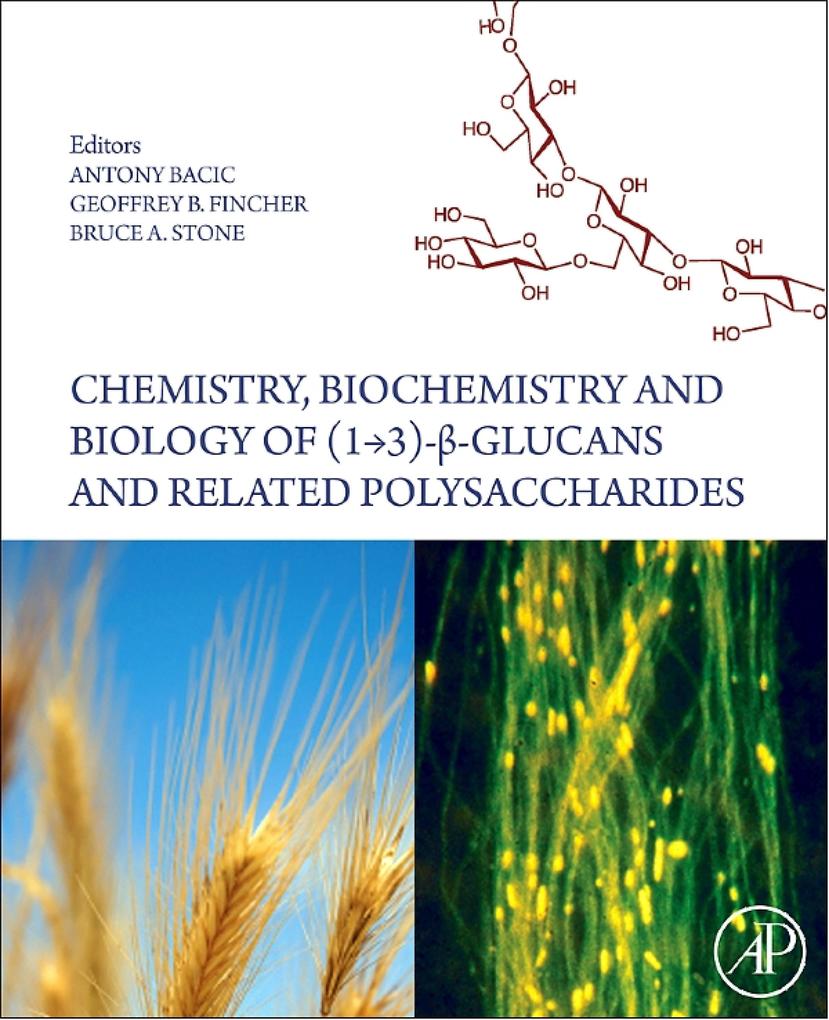
Chemistry, Biochemistry, and Biology of 1-3 Beta Glucans and Related Polysaccharides presents a comprehensive, systematic and authoritative survey of information about a family of chemically related, but functionally diverse, naturally occurring polysaccharides--the (1-3)-glucans. International contributors describe the chemical and physicochemical properties of these glucans and their derivatives and the molecular biological and structural aspects of the enzymes involved in their formation and breakdown. A detailed analysis of their physiological roles in the various biological situations in which they are found will be provided. Additionally, evolutionary relationships among the family of these glucans will be described.
- Topics of medical relevance include detailing the glucans' interactions with the immune system and research for cancer therapy applications
- Web resource links allow scientists to explore additional beta glucan research
- Separate indexes divided into Species and Subject for enhanced searchability
Inhaltsverzeichnis
1;Front Cover;1 2;Chemistry, Biochemistry, and Biology of (1→3)-β-Glucans and Related Polysaccharides;4 3;Copyright Page;5 4;Contents;6 5;In Memoriam;10 6;Acknowledgements;14 7;Contributors;16 8;Chapter 1. Introduction and Historical Background;20 9;Chapter 2. CHEMISTRY AND PHYSICO-CHEMISTRY;24 9.1;2.1 Chemistry of β-Glucans;24 9.2;2.2 Physico-chemistry of (1,3)-β-Glucans;66 10;Chapter 3. BIOCHEMISTRY;138 10.1;3.1 Plant and Microbial Enzymes Involved in the Depolymerization of (1,3)-β-D-Glucans and Related Polysaccharides;138 10.2;3.2 Interactions between Proteins and (1,3)-β-Glucans and Related Polysaccharides;190 10.3;3.3 Biosynthetic Enzymes;220 10.3.1;3.3.1 Enzymology and Molecular Genetics of Biosynthetic Enzymes for (1,3)-β-Glucans: Prokaryotes;220 10.3.2;3.3.2 Biosynthetic Enzymes for (1,3)-β-Glucans and (1,3;1,6)-β-Glucans in Protozoans and Chromistans: Biochemical Characterization and Molecular Biology;252 10.3.3;3.3.3 Biosynthetic Enzymes for (1-3)-β-Glucans, (1-3;1-6)-β-Glucans from Yeasts: Biochemical Properties and Molecular Biology;278 10.3.4;3.3.4 Biochemical and Molecular Properties of Biosynthetic Enzymes for (1,3)-β-Glucans in Embryophytes, Chlorophytes and Rhodophytes;302 11;Chapter 4. BIOLOGY;346 11.1;4.1 Functional Roles of (1,3)-β-Glucans and Related Polysaccharides: Prokaryotes;346 11.2;4.2 Biology of (1,3)-β-Glucans and Related Glucans in Protozoans and Chromistans;372 11.3;4.3 Organization of Fungal, Oomycete and Lichen (1,3)-β-Glucans;406 11.4;4.4 Rhodophytes, Chlorophytes and Embryophytes;444 11.4.1;4.4.1 Callose in Cell Division;444 11.4.2;4.4.2 Cytology of the (1-3)-β-Glucan (Callose) in Plasmodesmata and Sieve Plate Pores;458 11.4.3;4.4.3 Callose and its Role in Pollen and Embryo Sac Development in Flowering Plants;484 11.4.4;4.4.4 Callose in Abiotic Stress;518 11.4.5;4.4.5 Callose in Biotic Stress (Pathogenesis) Biology, biochemistry and molecular biology
of callose in plant defence: callose deposition and turnover in plantpathogen interactions;544 11.5;4.5 (1→3)-β-Glucans in Innate Immunity;582 11.5.1;4.5.1 Biological and Immunological Aspects of Innate Defence Mechanisms Activated by (1,3)-β-Glucans and Related Polysaccharides in Invertebrates;582 11.5.2;4.5.2 (1,3)-β-Glucans in Innate Immunity: Mammalian Systems;598 11.6;4.6 Distribution, Fine Structure and Function of (1,3;1,4)-β-Glucans in the Grasses and Other Taxa;640 11.7;4.7 Evolutionary Aspects of (1,3)-β-Glucans and Related Polysaccharides;674 12;Index;682 12.1;A;682 12.2;B;683 12.3;C;685 12.4;D;688 12.5;E;688 12.6;F;689 12.7;G;689 12.8;H;690 12.9;I;690 12.10;J;690 12.11;K;690 12.12;L;690 12.13;M;691 12.14;N;691 12.15;O;692 12.16;P;692 12.17;Q;693 12.18;R;693 12.19;S;694 12.20;T;695 12.21;U;695 12.22;V;695 12.23;W;695 12.24;X;695 12.25;Y;695 12.26;Z;696 13;Colour Plates;698