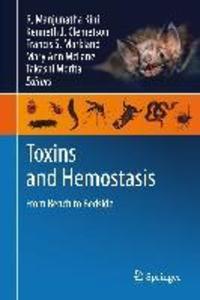
Circulation of blood is vital for the survival of vertebrates, including man. Mainly, it plays an important role in carrying food nutrients and oxygen to every tissue and organ and in removing all waste products and carbon dioxide. Any imbalance in the hemostatic and cardiovascular systems can lead to death and severe debility. A number of animals have developed mechanisms to target these systems and exploit the vulnerability. In some species (for example, snakes), such mechanisms are used to immobilize and kill the victim/prey, whereas in others (for example, insects, such as leaches, mosquitoes and ticks), they are used to provide a continuous supply of blood. These mechanisms include, but are not limited to, procoagulant and anticoagulant actions that affect the coagulation cascade and platelet aggregation, as well as altering vasodilatory responses. In all these various animals, these mechanisms have evolved to perfection over millions of years to support their survival. In last 3-4 decades, due to the efforts of scientists from various backgrounds including biology, protein chemistry, molecular biology, pharmacology, hematology, and structural biology, significant progress in understanding the structure-function relationships, as well as the mechanism of action have been made in a number of exogenous factors that affect blood coagulation, platelet aggregation and vasodilation from various animals. These exogenous factors have contributed significantly to the development of research tools as well as providing new therapeutic agents.
With the increase average age of the population coupled with changes in life style in recent years, there has been a significant increase in cardiovascular and hematological disorders. Thus scientists in both academic institutions as well as the pharmaceutical industry are developing better therapeutic agents to improve the quality of life. This impetus has lead to the search for novel agents from various sources that interfere withcardiovascular and hematalogical processes.
Although at first glance exogenous factors appear to function as 'villains', several life-saving drugs have been developed based upon these factors. Such drugs or drug leads include those that inhibit the angiotensin converting enzymes (Captopril and Enalapril), that block platelet receptors (Eptifibatide and Tirofiban), or that digest thrombotic plugs (Alfimeprase and bat plasminogen activator) to name a few. Several new and exciting success stories are currently unfolding. In this book, recent studies on some of the exogenous factors that play crucial roles in cardiovascular and hematological disorders are reviewed in order to consolidate the efforts in this area of research and to recruit new, talented researchers. The 25-30 review chapters, each written by experts in their field, compiled herein are devoted to exogenous factors affecting platelet aggregation, anticoagulant and procoagulant proteins, fibrinolytic proteins and hypotensive agents (For details see, Contents of the Book).
This book is intended to help to create elevated awareness and enthusiasm in the field of exogenous factors. I believe that this book will provide greater impetus to the search for novel proteins based on naturally occurring exogenous factors. This will be the first book dealing extensively with exogenous factors in the last 25 years. The book will provide a ready reference to the different approaches used to solve complex problems in protein chemistry and pharmacology of exogenous factors. The book will update our understanding of the structure-function relationships and mechanisms of action of exogenous factors and provide great insights into future directions for solving the remaining challenges.
Inhaltsverzeichnis
1;Preface;5 2;Acknowledgments;8 3;Contents;10 4;Contributors;14 5;About the Editors;19 6;Introduction;22 7;From Bench to Bedside;31 7.1;From the Bothrops Jararaca Bradykinin Potentiating Peptides to Angiotensin Converting Enzyme Inhibitors;32 8;The Omics The Search Is On;37 8.1;Sialomic Perspectives on the Evolution of Blood- Feeding Behavior in Arthropods: Future Therapeutics by Natural Design;38 8.2;Snake Venomics, Antivenomics, and Venom Phenotyping: The Ménage à Trois of Proteomic Tools Aimed at Understanding the Biodiversity of Venoms;62 8.3;Insights in to Venom and Toxin Activities and Pharmacological/ Therapeutic Potential Using Gene Expression Profiling;90 8.4;Bioactive Peptides and Proteins from Wasp Venoms;99 8.5;The Theory of Intraspecies Variation is Not the Exception, But Simply the Rule: The Diverse Hemostatic Activities of Snake Venoms;112 8.6;Tiny Ticks are Vast Sources of Antihaemostatic Factors;128 8.7;Sialogenins and Immunomodulators Derived from Blood Feeding Parasites;146 8.8;Salivary Protease Inhibitors with Non Anti- Hemostatic Functions;168 9;Anticoagulant Proteins;180 9.1;Blood Coagulation Factor IX/Factor X- Binding Protein;181 9.2;Bothrojaracin A Potent Thrombin Inhibitor;192 9.3;Anticoagulant Phospholipases A2 Which Bind to the Specific Soluble Receptor Coagulation Factor Xa;214 9.4;Hematophagy and Inhibition of the Extrinsic and Intrinsic Tenase Complexes;231 9.5;Thrombin Inhibitors from Haematophagous Animals;250 9.6;Anticoagulants from Scorpion Venoms;266 10;Antiplatelet Proteins;278 10.1;The Discovery of Disintegrins;279 10.2;Brief History and Molecular Determinants of Snake Venom Disintegrin Evolution;295 10.3;Anti-Angiogenesis and Disintegrins;311 10.4;Hematophagy and Inhibition of Platelet Aggregation;340 10.5;Snaclecs (Snake C-Type Lectins) that Inhibit Platelet Receptors;367 11;Fibrinolytic Proteins;377 11.1;Plasminogen Activators from Snake Venoms;378 11.2;Bat Plasminogen Activator: Desmoteplase From Bat to Bench to Bedside of S
troke Victims;400 11.3;Fibrolase and Its Evolution to Clinical Trials: A Long andWinding Road;415 11.4;Streptokinase;434 12;Procoagulant Proteins;450 12.1;Activation of Factor X by Snake Venom Proteases;451 12.2;Structural Aspects of the Factor X Activator RVV- X from Russells Viper Venom;469 12.3;Snake Venom Prothrombin Activators The History;489 12.4;Origin and Evolution of Snake Venom Prothrombin Activators;504 12.5;Thrombin-Like Enzymes in Snake Venoms;521 12.6;Procoagulant Factors from Lonomia Caterpillars;560 12.7;Staphylocoagulase;576 12.8;Procoagulant Properties of Plant Latex Proteases;592 13;Platelet Aggregation Inducers;605 13.1;The Biologic Activity of Aggretin/Rhodocytin, a Snake Venom C- Type Lectin Protein ( Snaclec);606 13.2;Snaclecs (Snake C-Type Lectins) that Activate Platelets;620 13.3;The Effect of Bacterial Toxins on Platelet Function;636 14;Hypotensive Factors;651 14.1;Hypertensive and Hypotensive Snake Venom Components;652 14.2;Hypotensive Proteins from Hematophagous Animals;670 15;Hemorrhage and Coagulopathies;694 15.1;Snakebite-Induced Coagulopathy and Bleeding Disorders;695 15.2;Antivenoms and Coagulation;707 15.3;Biological Activities of Snake Venom Metalloproteinases on Platelets, Neutrophils, Endothelial Cells, and Extracellular Matrices;718 16;Applications;728 16.1;Leeches in Microsurgery An Evidence-Based Approach;729 16.2;Diagnostic Use of Snake Venom Components in the Coagulation Laboratory;740 17;Index;760