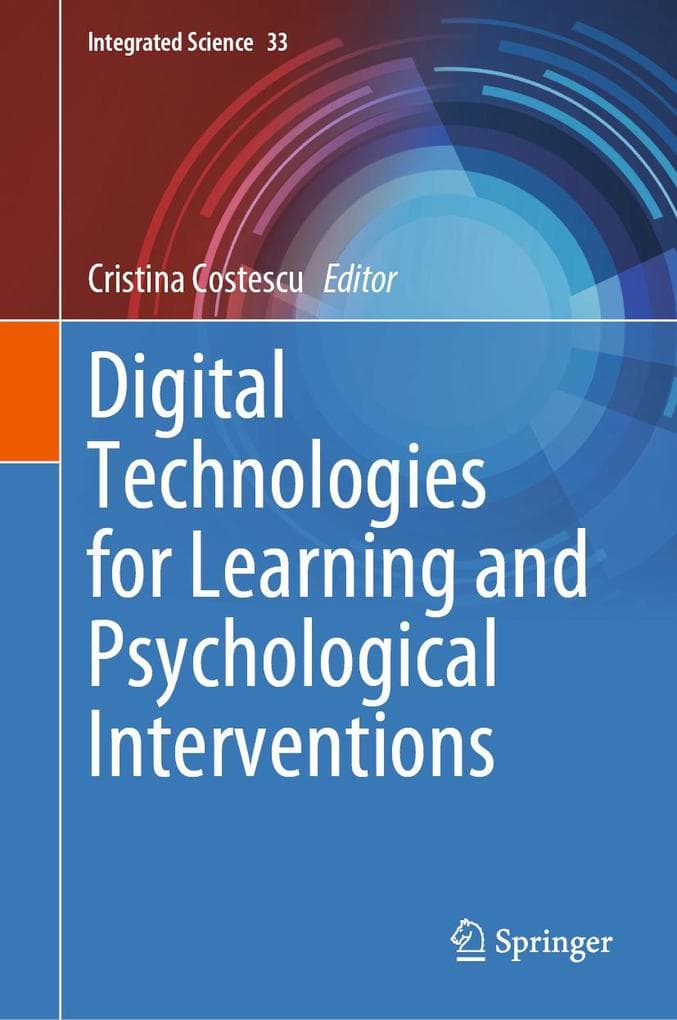
This edited volume presents the latest research focussing on current challenges on the deployment of smart technologies and pedagogies for supporting teaching and learning in the post-covid19 era. This is at the core of studying the evolution of the learning process, the role of technology-supported pedagogical approaches, and the progress of educational technology innovations in the context of digital transformation in education and professional training.
A selection of the best papers from the Cognition and Exploratory Learning in the Digital Age (CELDA) Conference, 2022 are included in this volume, bringing together high-quality research on Smart Pedagogies in the Post-Pandemic Era; Smart Learning Technologies in the Post-Pandemic Era; and Case Studies of Smart Learning Environments. The volume contributes to the discussion of current issues in digital education between researchers, practitioners, and policymakers.
Inhaltsverzeichnis
Part I Smart Pedagogies in the Post-Pandemic Era: Chapter 1 Learning Analytics in Supporting Teaching and Learning Pedagogical Perspectives (Laura Hirsto, Sanna Väisänen, Erkko Tapio Sointu & Teemu Valtonen). - Chapter 2 Learning Analytics Based Interventions: a Systematic Re-view of Experimental Studies (Mustafa Tepgeç, Dirk Ifenthal-er). - Chapter 3 Experiencing Flow in Virtual Reality: an Investigation of Complex Interaction Structures of Learning-related Variables (Miriam Mulders). - Chapter 4 Determining Learners Behavioral Patterns in a Technolo-gy and Analytics Enhanced Assessment Environment (Muhittin ahin, Dirk Ifenthaler). - Chapter 5 Clustering Techniques to Investigate Engagement and Performance in Online Mathematics Courses (Francesco Floris, Marina Marchisio, Fabio Roman, Matteo Sacchet, Sergio Rabellino). - Part II: Smart Learning Technologies in the Post-Pandemic Era: Chapter 6 Automatic Speech Recognition System to Enhance the Use of Vocalization Strategy (Saki Hirata Masanori Yamada). - Chapter 7 An Educational Unified Modelling Language Program-ming Environment and its two Case Studies (Maruyama, Shinpei Ogata, Mizue Kayama, Nobuyuki Tachi, Takashi Na-gai, Naomi Taguchi). - Chapter 8 Physical Computing Systems: a Systematic Approach (Er-ic Schätz and Alke Martens). - Chapter 9 a Digital Educational Game for Practicing OER (Lubna Ali, Quang Phung, Rene Roepke, Ulrik Schroeder). - Part III Case Studies of Smart Learning Environments: Chapter 10 Student Acceptance of Social Robots in Higher Education: Evidence from a Vignette Study (Josef Guggemos, Stefan Sonderegger and Sabine Seufert). - Chapter 11 Evaluating Different Assessment Types in an Online Geoscience Course (Emre Dinç, April L. Millet). - Chapter 12 Students Use of Learning Aids: Lessons from LearningAnalytics (Dirk Tempelaar). - Chapter 13 Didactic Activities of Artificial Intelligence: the Perspec-tive of STEM Teachers (Cecilia Fissore, Francesco Floris, Ma-rina Marchisio and Matteo Sacchet). - Part IV Looking To The Future: Chapter 14 Is it time to consider Biomimetics for sustainable educa-tion? Lessons from the nature for smarter learning environ-ments (Boulus Shehata, Ahmed Tlili, Demetrios Sampson, Ronghuai Huang).