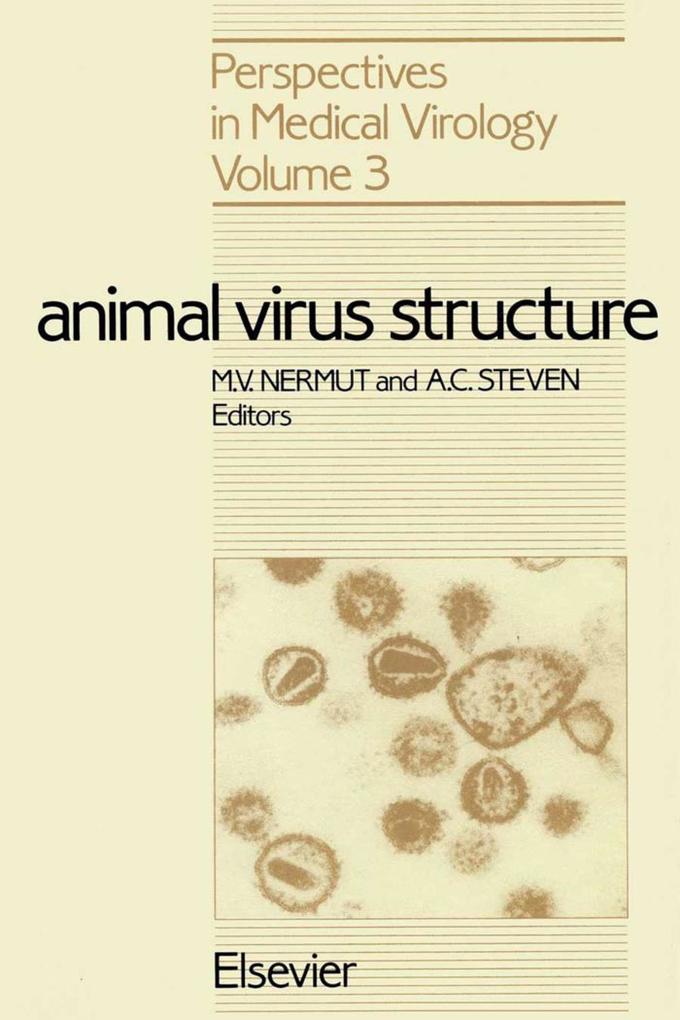
Animal Virus Structure provides a comprehensive, state-of-the-art summary of the structure, molecular composition, and principal antigenic and biological properties of each currently recognized family of animal viruses. Information deriving from electron microscopy, computer image processing and X-ray diffraction is integrated systematically with biochemical data into three-dimensional molecular models of viral architecture. A brief account of virus/cell interaction and pathogenicity completes each chapter.
Inhaltsverzeichnis
1;Front Cover;1 2;Animal Virus Structure;4 3;Copyright Page;5 4;Contents;14 5;Editors' foreword;6 6;List of contributors;10 7;Part I. General principles of virus architecture;24 7.1;Chapter 1. General principles of virus architecture;26 7.1.1;1.1. Introduction;26 7.1.2;1.2. Brief survey of virus anatomy;27 7.1.3;1.3. Symmetries associated with viruses;32 7.1.4;1.4. The meaning of quasi-equivalence and deviations from the doctrine;39 8;Part II. Methods for the study of virus structure;42 8.1;Chapter 2A. Electron microscopy: methods for 'structural analysis' of the virion;44 8.1.1;2.A.1. Negative staining;44 8.1.2;2.A.2. Shadowing techniques;49 8.1.3;2.A.3. Low-temperature techniques in virus research;50 8.1.4;2.A.4. Tactics of structural analysis of viruses;53 8.2;Chapter 2B. Electron microscopy: methods for studies of virus/cell interactions;58 8.2.1;2B.1. Ultra-thin sectioning;58 8.2.2;2B.2. Scanning electron microscopy (SEM);62 8.2.3;2B.3. Replica techniques;66 8.2.4;2B.4. Immuno-electron microscopy in virology;69 8.3;Chapter 2C. Electron microscopy: image processing and quantitative electron microscopy;84 8.3.1;2C.1. Image analysis and image processing;84 8.3.2;2C.2. Scanning transmission electron microscopy (STEM);91 8.3.3;2C.3. Conclusions;94 8.4;Chapter 3. X-ray diffraction from viruses;98 8.4.1;3.1. Introduction;98 8.4.2;3.2. Crystallization;99 8.4.3;3.3. Data collection;104 8.4.4;3.4. Data processing;105 8.4.5;3.5. Components of viruses;107 8.4.6;3.6. Filamentous specimens;108 8.4.7;3.7. Solution scattering;109 8.5;Chapter 4. Neutron scattering;112 8.5.1;4.1. Introduction;112 8.5.2;4.2. Theory;112 8.5.3;4.3. Experimental conditions;114 8.5.4;4.4. The determination of the virus molecular weight and of its radius of gyration;116 8.5.5;4.5. The determination of a model of the virus;116 8.5.6;4.6. Conclusion;118 9;Part III. Taxonomy of animal viruses;120 9.1;Chapter 5. Taxonomy of animal viruses;122 9.2;5.1. Introduction;122 9.3;5.2. The ICTV universal system of
virus taxonomy;123 10;Part IV. RNA-containing virus families;128 10.1;Chapter 6. Picornaviridae;130 10.1.1;6.1. General characteristics;130 10.1.2;6.2. Enteroviruses: species poliovirus;131 10.1.3;6.3. Enterovirus: species hepatitis A virus;136 10.1.4;6.4. Aphthoviruses: species foot-and-mouth disease virus;137 10.1.5;6.5. Rhinovirus: species HRV 14, HRV 2;137 10.1.6;6.6. Cardioviruses: species Encephalomyocarditis virus, Mengovirus;138 10.1.7;6.7. Viruscell interactions;139 10.2;Chapter 7. Caliciviridae;144 10.2.1;7.1. General characteristics;144 10.2.2;7.2. Chemical and physical characteristics;144 10.2.3;7.3. Structural characteristics;145 10.2.4;7.4. Architecture of the virus;148 10.2.5;7.5. Antigenic properties;150 10.2.6;7.6. Biological properties;151 10.3;Chapter 8. Birnaviridae;152 10.3.1;8.1 General characteristics;152 10.3.2;8.2. Chemical and physical characteristics;152 10.3.3;8.3. Structural characteristics;154 10.3.4;8.4. Architecture of the virus particle;154 10.3.5;8.5. Antigenic properties;155 10.3.6;8.6. Biological properties;156 10.4;Chapter 9. Reoviridae;158 10.4.1;9.1. General characteristics;158 10.4.2;9.2. Orthoreovirus: species Reovirus type 3 (Dearing strain);159 10.4.3;9.3. Rotavirus: species Simian rotavirus SA-11;164 10.4.4;9.4. Orbivirus: species Bluetongue virus (BTV);165 10.4.5;9.5. Cypovirus: species Cytoplasmic polyhedrosis virus (CPV-I);166 10.4.6;9.6. Phytoreovirus: species Wound tumor virus (WTV);167 10.4.7;9.7. Fijivirus: species Fiji desease virus (FDV);168 10.5;Chapter 10. Bunyaviridae;170 10.5.1;10.1. General characteristics;170 10.5.2;10.2. Chemical and physical characteristics;172 10.5.3;10.3. Structural characteristics;172 10.5.4;10.4. Structural complexes - chemistry and organization;173 10.5.5;10.5. The structural model;178 10.5.6;10.6. Biological properties;178 10.6;Chapter 11. Togaviridae;182 10.6.1;11.1. General characteristics;182 10.6.2;11.2. Physical and chemical characteristics;183 10.6.3;11.3. Structural character
istics;184 10.6.4;11.4. Architecture of the virion;186 10.6.5;11.5. Replication of the togaviruses;188 10.7;Chapter 12. Coronaviridae;196 10.7.1;12.1. General characteristics;196 10.7.2;12.2. Chemical and physical characteristics;197 10.7.3;12.3. Structural characteristics;198 10.7.4;12.4. Antigenic properties;202 10.7.5;12.5. Biological properties;205 10.8;Chapter 13. Arenaviridae;208 10.8.1;13.1. General properties;208 10.8.2;13.2. Physical and chemical properties;209 10.8.3;13.3. Structural characteristics;211 10.8.4;13.4. Architecture of the virion;211 10.8.5;13.5. Antigenic properties;219 10.8.6;13.6. Viruscell interactions;219 10.9;Chapter 14. Rhabdoviridae;222 10.9.1;14.1. General characteristics;222 10.9.2;14.2. Physical and chemical properties of VSV;223 10.9.3;14.3. VSV architecture;229 10.9.4;14.4. Antigenic properties;231 10.9.5;14.5. Detergent-mediated disassembly of VSV and reassembly;231 10.9.6;14.6. Viruscell interactions;232 10.10;Chapter 15. Orthomyxoviridae;236 10.10.1;15.1. General characteristics;236 10.10.2;15.2. Chemical and physical characteristics;237 10.10.3;15.3. Structural characteristics;239 10.10.4;15.4. Architecture of the virion;239 10.10.5;15.5. Antigenic properties of influenza virus;251 10.10.6;15.6. Viruscell interactions;252 10.11;Chapter 16. Paramyxoviridae;256 10.11.1;16.1. General characteristics;256 10.11.2;16.2. Parainfluenza virus type 1 (Sendai virus): chemical and physical Characteristies;257 10.11.3;16.3. Structural characteristics;257 10.11.4;16.4. Architecture of the virion;258 10.11.5;16.5. Antigenic properties;266 10.11.6;16.6. Virus-cell interactions;268 10.11.7;16.7. Pathogenicity;270 10.12;Chapter 17A. Retroviridae;276 10.12.1;17A.1. General characteristics;276 10.12.2;17A.2. Oncovirinae;277 10.12.3;17A.3. Lentivirinae;279 10.12.4;17A.4. Spumavirinae;279 10.13;Chapter 17B(i). Oncovirinae: type B oncovirus;280 10.13.1;17B(i).1. General characteristics;280 10.13.2;17B(i).2. Morphology of MuMTV;281 10.13.3;17B(i).3.
Physical and chemical characteristics;281 10.13.4;17B(i).4. Organization of the virus surface;285 10.13.5;17B(i).5. The internal structure of MuMTV;287 10.13.6;17B(i).6. Biological properties of MuMTV;289 10.13.7;17B(i).7. MuMTV replication;291 10.13.8;17B(i). 8. Concluding remarks;294 10.14;Chapter 17B(ii). Oncovirinae: type C oncovirus;296 10.14.1;17B(ii).1. General characteristics;296 10.14.2;17B(ii).2. Chemical and physical characteristics;297 10.14.3;17B(ii).3. Architecture of the virion;298 10.14.4;17B(ii).4. 'Immature' and 'mature' cores;304 10.14.5;17B(ii).5. Morphological aberrations;306 10.14.6;17B(ii).6. The model of a C-type virion;306 10.14.7;17B(ii).7. Viruscell interaction;307 10.14.8;17B(ii).8. C-type viruses of human origin;308 10.15;Chapter 17B(iii). Oncovirinae: type D oncovirus;312 10.15.1;17B(iii).1. General characteristics;312 10.15.2;17B(iii).2. Chemical and physical characteristics;313 10.15.3;17B(iii).3. Architecture of the virion;313 10.15.4;17B(iii).4. Viruscell and virushost interaction;315 10.16;Chapter 17C. Lentivirinae;318 10.16.1;17C.1. General characteristics;318 10.16.2;17C.2. Chemical and physical characteristics;320 10.16.3;17C.3. Architecture of the virion;323 10.16.4;17C.4. Viruscell interactions;325 10.17;Chapter 17D. Spumavirinae;328 10.17.1;17D.1. Introduction;328 10.17.2;17D.2. Physical and chemical characteristics;329 10.17.3;17D.3. Fine structure and morphogenesis;331 10.17.4;17D.4. Pathogenicity;333 10.18;Chapter 18. The filoviridae;336 10.18.1;18.1. Origin and general features;336 10.18.2;18.2. Some chemical and physical characteristics;336 10.18.3;18.3. Antigenic properties;337 10.18.4;18.4. Structural characteristics;337 10.18.5;18.5. Virus-cell and virushost interaction;339 11;Part V. DNA-containing virus families;346 11.1;Chapter 19. Parvoviridae;348 11.1.1;19.1. General characteristics;348 11.1.2;19.2. Chemical and physical characteristics;351 11.1.3;19.3. Antigenic properties;353 11.1.4;19.4. Architecture of the vi
rion;353 11.1.5;19.5. Viruscell interaction;356 11.2;Chapter 20. Papovaviridae;358 11.2.1;20.1. General characteristics;358 11.2.2;20.2. Polyoma virus (Py): physical and chemical characteristics;359 11.2.3;20.3. Architecture of the virion;360 11.2.4;20.4. Antigenic properties;368 11.2.5;20.5. Biological properties;368 11.2.6;20.6. Other Papovaviruses;370 11.3;Chapter 21. Baculoviridae;372 11.3.1;21.1. General characteristics;372 11.3.2;21.2. Chemical and physical characteristics;373 11.3.3;21.3. Structural characteristics;373 11.3.4;21.4. Architecture of virus particles;376 11.3.5;21.5. Antigenic properties;380 11.3.6;21.6. Biological properties;380 11.3.7;21.7. Pathogenicity;383 11.4;Chapter 22. Hepadnaviridae;384 11.4.1;22.1. General characteristics;384 11.4.2;22.2. Human hepatitis B virus: structural characteristics;386 11.4.3;22.3. Physico-chemical properties;388 11.4.4;22.4. Antigenic properties;391 11.4.5;22.5. Biological properties;393 11.4.6;22.6. Other hepadna viruses;393 11.5;Chapter 23. Adenoviridae;396 11.5.1;23.1. General characteristics;396 11.5.2;23.2. Human adenovirus: chemical and physical characteristics;396 11.5.3;23.3. Structural characteristics;397 11.5.4;23.4. Architecture of the virion;398 11.5.5;23.5. Biological properties;408 11.5.6;23.6. Aviadenovirus;410 11.6;Chapter 24. Herpesviridae;414 11.6.1;24.1. General characteristics;414 11.6.2;24.2. Physical and chemical characteristics;415 11.6.3;24.3. Architecture of the virion;415 11.6.4;24.4. Locations and functions of proteins present in herpes virions;423 11.6.5;24.5. Antigenic properties;425 11.6.6;24.6. Viruscell interactions;426 11.7;Chapter 25. Iridoviridae;430 11.7.1;25.1. General characteristics;430 11.7.2;25.2. Physical and chemical characteristics;432 11.7.3;25.3. Architecture;434 11.7.4;25.4. Viruscell interactions;438 11.7.5;25.5. Pathogenicity;438 11.8;Chapter 26. Poxviridae;444 11.8.1;26.1. General characteristics;444 11.8.2;26.2. Chemical and physical characteristics;445 11.8.3;
26.3. Structural characteristics;448 11.8.4;26.4. Architecture of the virion;448 11.8.5;26.5. Antigenic properties;450 11.8.6;26.6. Biological properties;452 12;Subject index;458