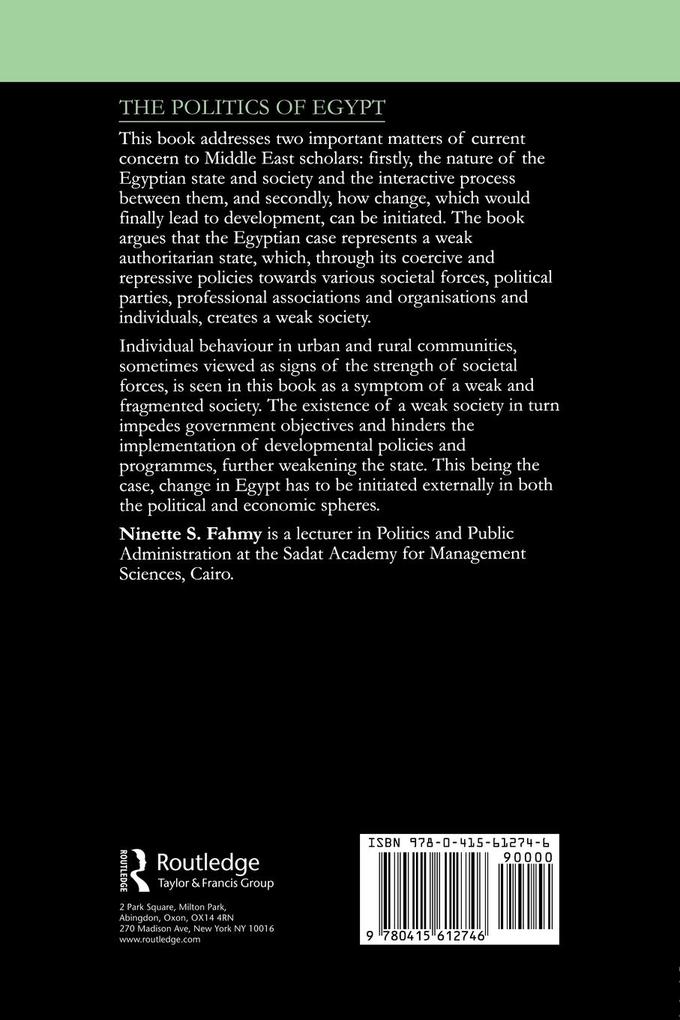
This books addresses two important dimensions of current concern to Middle Eastern scholars: firstly, the nature of the Egyptian state and society, and the interactive process between them, and secondly, how change leading to development can be initiated.
This book addresses two important matters of current concern to Middle East scholars: firstly, the nature of the Egyptian state and society and the interactive process between them and secondly, how change, which would finally lead to development, can be initiated. The book argues that the Egyptian case represents a weak authoritarian state, which through its coercive and repressive policies towards various societal forces, political parties, professional associations and organisations and individuals, creates a weak society. Individual behaviour in urban and rural communities, sometimes viewed as signs of the strength of societal forces, is seen here as a symptom of a weak and fragmented society. The existence of a weak society in turn impedes government objectives and hinders the implementation of developmental policies and programmes, further weakening the state. This being the case, change has to be initiated externally in both the political and economic spheres.
Inhaltsverzeichnis
1. Theories of State and Society 2. The Historical Relationship between the State and the Peasants 3. The Constitutional and Legal System in Egypt and the Change to a Multi-Party System 4. Political Parties in Egypt 5. Egyptian Professional Associations 6. Labour and Business Organisations 7. The Local System in Egypt: A Blocked Avenue for Participation and Representation 8. The State, Peasant Politics and Development: The Inherent Dilemma 9. Tihna al-Gabal: A Case Study of a Village in Upper Egypt 10. Conclusion