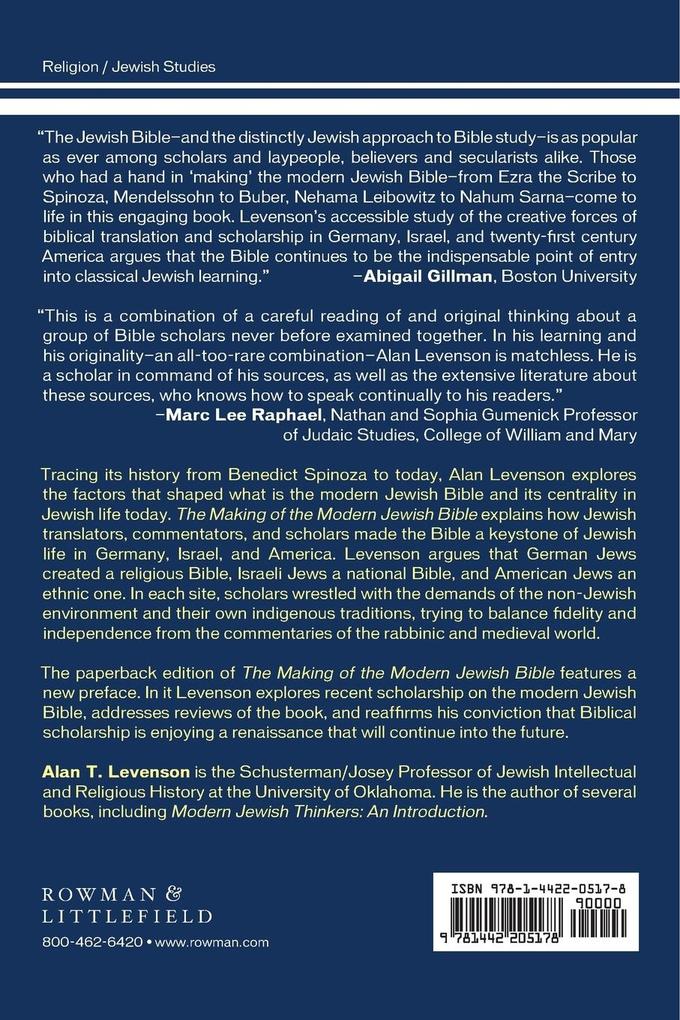
The Making of the Modern Jewish Bible explains how Jewish translators, commentators, and scholars made the Bible a keystone of Jewish life in Germany, Israel and America. In each site, a particular need-religion, nationalism, ethnicity-drove the enterprise of Bible study as scholars wrestled with the demands of the non-Jewish environment and their own indigenous traditions. Contrary to popular conceptions, the author argues that the modern period has been the golden age of Jewish Bible study.
Inhaltsverzeichnis
Introduction
Chapter 1: Spinoza As Jewish Bible Critic
Part I. The Emergence of Modern Jewish Bible Studies in Germany
Introduction: Starting with Germany
Chapter 2: Mendelssohn's Bible: The Ideal of Jewish Self-Sufficiency
Chapter 3: Samson Raphael Hirsch: The Chimera of Self-Explanatory Scripture
Chapter 4: Benno Jacob and the Call for a "Jewish" Bible Scholarship
Chapter 5: The Martin Buber-Franz Rosenzweig Bible: Culture or Religion?
Part II. Zionism and the Creation of a National Bible
Introduction: The Bible in Modern Israel
Chapter 6: Early Zionism and the Bible: Ahad Haam and His Opponents
Chapter 7: The Bible As National Linchpin: David Ben Gurion and His Opponents
Chapter 8: Nehama Leibowitz's Bible: Returning Tradition to the Text
Part III. The Flowering of Jewish Bible Studies in North America
Introduction: America and the Jewish Bible
Chapter 9: Finding A Jewish Voice: Nahum Sarna & Robert Alter
Chapter 10: Seeking An American Jewish Bible
Conclusion: Is There A "Jewish