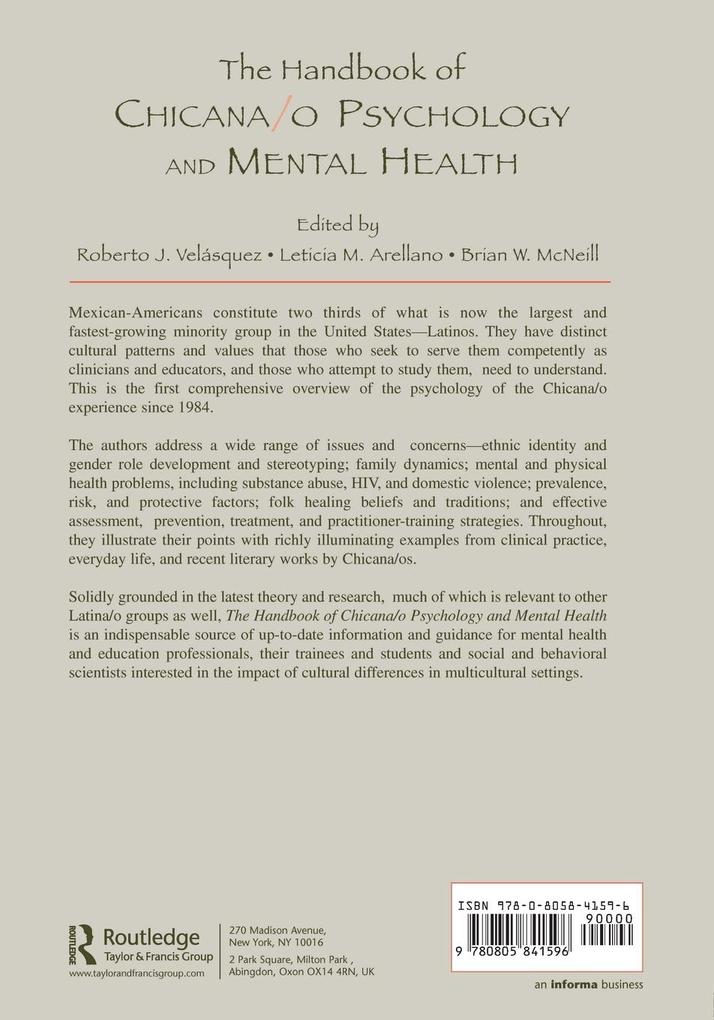
Mexican-Americans have distinct cultural patterns and values that those who seek to serve them competently as clinicians and educators or study them need to understand. Solidly grounded in the latest theory and research, the Handbook offers the first up-
Inhaltsverzeichnis
Contents: Preface. M.J.T. Vasquez, An Appreciation of Dr. Martha E. Bernal (1931-2001). Part I: Being and Becoming a Chicana/o: General Issues.M. Ramirez III, Mestiza/o and Chicana/o Psychology: Theory, Research, and Application. I. Cuéllar, R.I. Siles, E. Bracamontes, Acculturation: A Psychological Construct of Continuing Relevance for Chicana/o Psychology. E.M. Vera, S.M. Quintana, Ethnic Identity Development in Chicana/o Youth. Y.F. Niemann, Stereotypes of Chicanas and Chicanos: Impact on Family Functioning, Individual Expectations, Goals and Behavior. M. Barrera, Jr., N.A. Gonzales, V. Lopez, A.C. Fernandez, Problem Behaviors of Chicana/o and Latina/o Adolescents: An Analysis of Prevalence, Risk, and Protective Factors. M. Harris, R.J. Velásquez, J. White, T. Reneria, Folk Healing and Curanderismo Within the Contemporary Chicana/o Community: Current Status. Part II: Psychological Assessment of Chicana/os.S.R. López, A. Weisman, Integrating a Cultural Perspective in Psychological Test Development. R.J. Velásquez, M. Garrido, J. Castellanos, M.P. Burton, Culturally Competent Assessment of Chicana/os With the Minnesota Multiphasic Personality Inventory-2. Part III: Conceptualizing Effective Intervention: La Mujer y el Hombre.R.J. Velásquez, M.P. Burton, Psychotherapy of Chicano Men. R.A. Rodriguez, Psychotherapy With Gay Chicanos. L.M. Arellano, C. Ayala-Alcantar, Multiracial Feminism for Chicana/o Psychology. P. Arredondo, Psychotherapy With Chicanas. L. Baca, P. Hernandez, Group Therapy With Chicanas. Part IV: Conceptualizing Effective Intervention: La Familia.Y.G. Flores-Ortiz, Domestic Violence in Chicana/o Families. J.M. Cervantes, L.I. Sweatt, Family Therapy With Chicanas/os. Part V: Risks and Prevention.R.C. Cervantes, M. Félix-Ortiz, Substance Abuse Among Chicanos and Other Mexican Groups. K.C. Organista, Culturally and Socially Competent HIV Prevention With Mexican Farm Workers. F.G. Castro, N.T. Hernandez, A Cultural Perspective on Prevention Interventions. Part VI: New Directions.A.M. Gloria, T.A. Segura-Herrera, Ambrocia and Omar Go to College: A Psychosociocultural Examination of Chicana/os in Higher Education. B.W. McNeill, L.R. Prieto, F. Ortiz, C.A. Yamokoski, Cultural Competency: Teaching, Training, and the Delivery of Services for Chicana/os. J.D. Raley, J.M. Casas, C.V. Corral, Quality de Vida: Browning Our Understanding of Quality of Life. M.E. Bernal, Epilogue: Challenges and Opportunities for Chicana/o Psychologists: Past, Present, and Future.