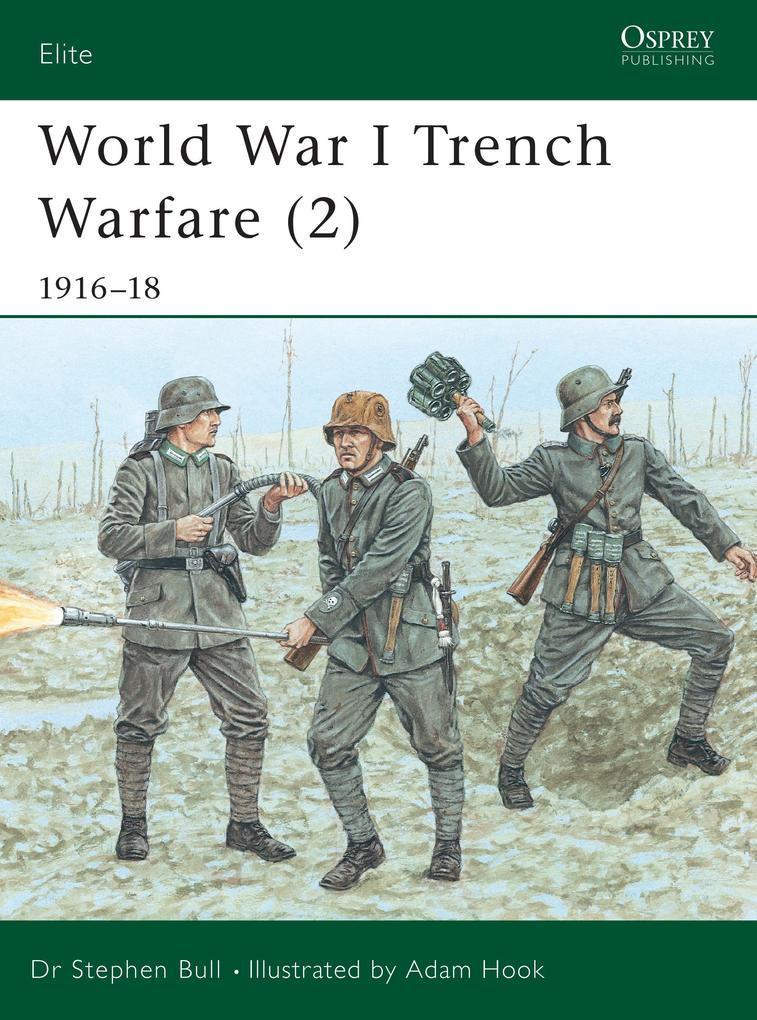
Osprey's examination of trench warfare tactics during World War I (1914-1918). The Allied attempt to break the stalemate of trench warfare by the 'big pushes' of 1916 led to massively costly battles of attrition. The Germans responded by developing schemes of defence in depth anchored on concrete bunkers; the Allies, by sophisticated artillery tactics in support of infantry assaults, and by the introduction of the tank - at first an accident-prone novelty, but later a front-breaking weapon. On both sides the small, self-reliant, opportunistic infantry unit, with its own specialist weapons, became the basic tool of attack. This second of a fascinating two-part study of the birth of 20th century tactics is illustrated in colour and includes rare photographs.
Inhaltsverzeichnis
1916; 'the big push' against established trench lines
The Somme
Standardised production of trench materials - trench camouflage
Advances in gas warfare
Infantry training
Light machine guns
1917: Messines & Vimy - tunnel and mine warfare
Creeping barrages - tanks - light machine guns down to section level - flame throwers
New defensive systems
1918: the deadlock broken
German stormtroopers, British 'blobs & worms'
Trench howitzers - anti-tank rifles - sub-machine guns
Battles: the Kaisershlacht - French and Americans on the Argonne - the British break the Hindenburg Line