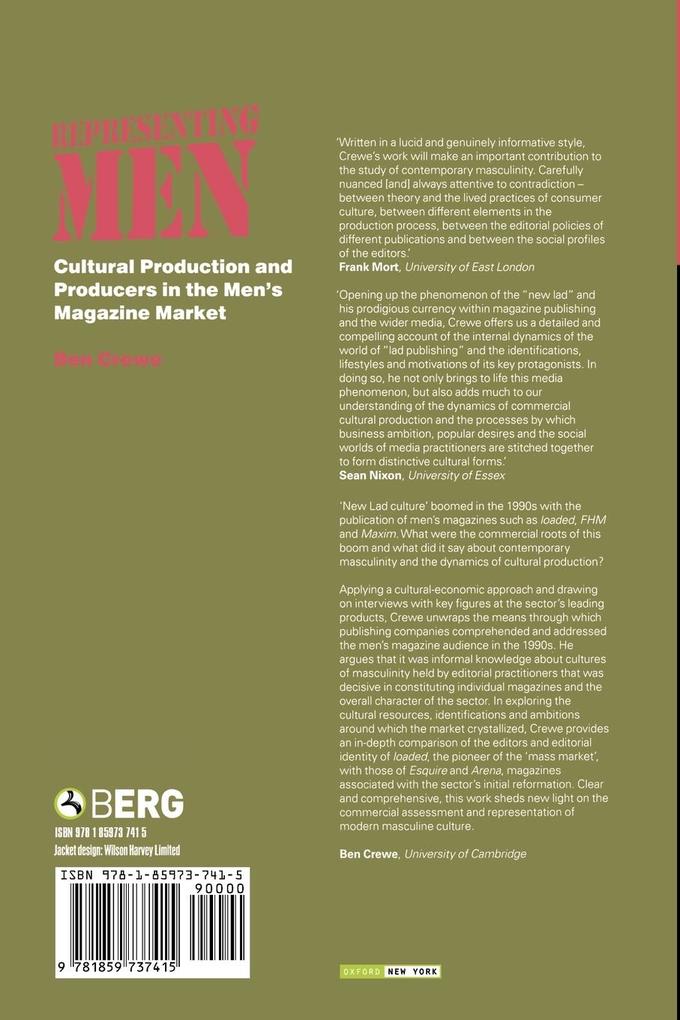
New Lad culture boomed in the 1990s with the publication of mens magazines such as loaded, FHM and Maxim. What were the commercial roots of this boom and what did it say about contemporary masculinity and the dynamics of cultural production? Applying a cultural-economic approach and drawing on interviews with key figures at the sectors leading products, Crewe unwraps the means through which publishing companies comprehended and addressed the mens magazine audience in the 1990s. He argues that it was informal knowledge about cultures of masculinity held by editorial practitioners that was decisive in constituting individual magazines and the overall character of the sector. In exploring the cultural resources, identifications and ambitions around which the market crystallized, Crewe provides an in-depth comparison of the editors and editorial identity of loaded, the pioneer of the mass market, with those of Esquire and Arena, magazines associated with the sectors initial reformation. Clear and comprehensive, this work sheds new light on the commercial assessment and representation of modern masculine culture.
Inhaltsverzeichnis
Part I
Magazines, masculinity and cultural analysis
1Literature review and conceptual orientation 25
Political economy and productionist paradigms 25
Post-Fordism and cultural economy 30
Cultural work, production and producers 36
Masculinity and the new man 46
The early years of the men's magazine market 54
A cultural economy of the mens press 61
Part II
The structure and dynamics of the UK mens press
2 The launches of the mid-1990s 64
The early nineties 65
The launch of loaded 72
The launch of FHM 80
The launch of Maxim 85
The launch of Mens Health 90
The new phase in the men's magazine market 93
Concluding comments 97
3 The logic of market launches 102
The institutional and economic context 104
Launch origins 109
Launch developments 114
Attitudes towards research 118
Summary and concluding comments 122
4 The terms of editorial power 128
i) Publishing structures and the editor-publisher relationship 131
Editing and publishing roles 131
Editors, publishers and organisational structures 136
ii) The methods, dynamics and determinants of editorial production 144
Assessing the reader 144
Editorial capital 153
Advertising imperatives and editorial conflicts, constraints and commitments 163
iii) The negotiation of editorial autonomy171
Selling creativity and the company context174
Market stability and editorial value179
Summary and concluding comments183
Part III
Editors and magazines
Introduction187
5Men who should know better? The editors of loaded 190
Class, education and mobility191
Masculinity and heterosexuality 199
Occupational identity 205
loaded 216
After loaded 227
Concluding comments236
6Editors in the mens style press239
i) Peter Howarth and Esquire240
Esquire: Man at his best240
Peter Howarths background and career247
Masculinity and heterosexuality251
Occupational identity 255
Howarths Esquire260
ii) Ekow Eshun and Arena 268
Ekow Eshuns background and identity268
Occupational identity 273
Arena: The original magazine for men276
Eshuns Arena279
Concluding comments286
Summary and Conclusion299
Appendix Research background, process and methods320
Bibliography333