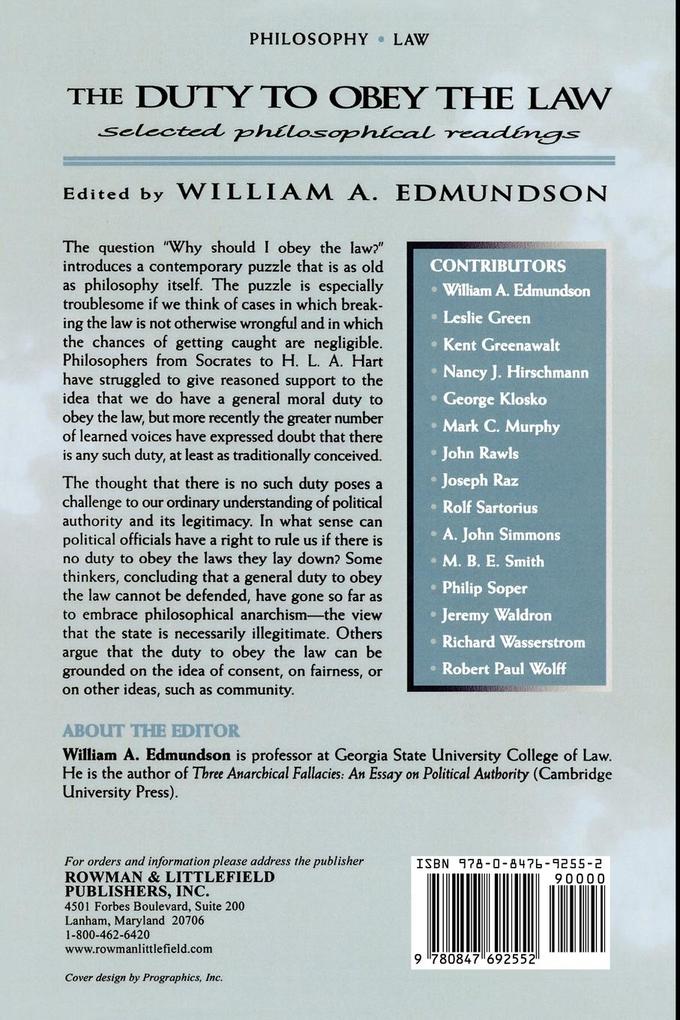
The question 'Why should I obey the law?' introduces a contemporary puzzle that is as old as philosophy itself. The puzzle is especially troublesome if we think of cases in which breaking the law is not otherwise wrongful, and in which the chances of getting caught are negligible. Philosophers from Socrates to H. L. A. Hart have struggled to give reasoned support to the idea that we do have a general moral duty to obey the law but, more recently, the greater number of learned voices has expressed doubt that there is any such duty, at least as traditionally conceived.
Inhaltsverzeichnis
Part 1 Acknowledgments
Part 2 Introduction
Chapter 3 1 The Obligation to Obey the Law
Chapter 4 2 The Justification of Civil Disobedience
Chapter 5 3 The Conflict between Authority and Autonomy
Chapter 6 4 Is There a Prima Facie Obligation to Obey the Law?
Chapter 7 5 The Principle of Fair Play
Chapter 8 6 Political Authority and Political Obligation
Chapter 9 7 The Obligation to Obey: Revision and Tradition
Chapter 10 8 Legitimate Authority and the Duty to Obey
Chapter 11 9 Presumptive Benefit, Fairness, and Political Obligation
Chapter 12 10 Legal Theory and the Claim of Authority
Chapter 13 11 Freedom, Recognition, and Obligation: A Feminist Approach to Political Theory
Chapter 14 12 Special Ties and Natural Duties
Chapter 15 13 Who Believes in Political Obligation?
Chapter 16 14 Surrender of Judgment and the Consent Theory of Political Authority
Part 17 Index