Bücher versandkostenfrei*100 Tage Rückgaberecht***Abholung in über 100 Filialen

Inhaltsverzeichnis
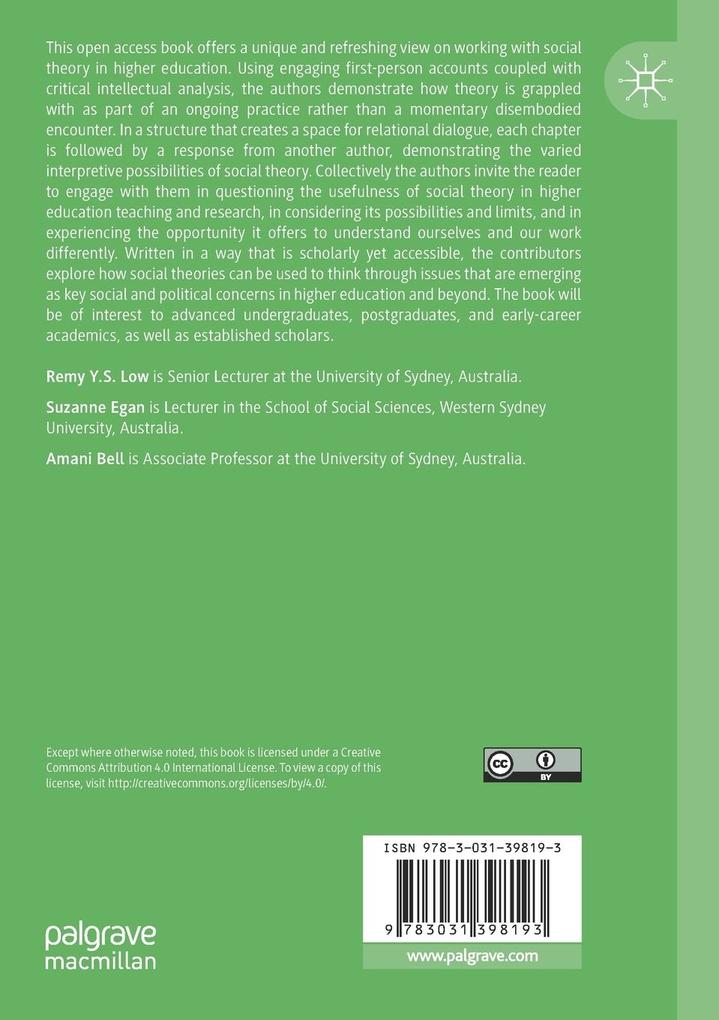
Chapter 1 Other people s ideas: An introduction to using social theory in higher education. - Chapter 2 Sit Down, be Humble: The influence of the Work of Linda Tuhiwai Smith on our research. - Chapter 3 The decolonial imperative - text and context: a response to Amani Bell and Gulwanyang Moran . - Chapter 4 After Belonging: Aileen Moreton-Robinson s `I Still Call Australia Home . - Chapter 5 In belonging: a response to Timothy Laurie . - Chapter 6 Deploying Rose and Abi-Rached to `make sense of the rise of the `brain sciences in the field of violence against women. - Chapter 7 What do we talk about when we talk about neuro? A response to Suzanne Egan. - Chapter 8 The power, passions, and perils of identity: On Chantal Mouffe, . - Chapter 9 Connections, engagements and troubles: a response to Remy Y. S. Low. - Chapter 10 The Foggy Window: Passive empathy and the fight for testimonial reading in neoliberal higher education. - Chapter 11 Performing empathy with neoliberalism, or Kendall Jenneron the streets, Thomas Gradgrind in the sheets: a response to Lauren Weber. - Chapter 12 Understanding higher education enrolment through Michel Foucault s biopolitics. - Chapter 13 Students, biopolitics, and state racism: a response to Ren-Hao Xu. - Chapter 14 Wrestling with monsters: critique, climate change, and comets. - Chapter 15 Still wrestling with monsters: a response to Pat Norman. - Chapter 16 Dialogues between activist knowledge and Southern Theory . - Chapter 17 Approximate Geographies: a response to José Fernando Serrano Amaya. - Chapter 18 The historian as pedagogue: on Hayden White s practical past. - Chapter 19 What stories to tell: a response to Remy Low . - Chapter 20 The good university? Colourful histories, ongoing troubles and changing contexts. - Chapter 21 The good university examined: a response to Meenakshi Krishnaraj, Ren-Hao Xu, and Pat Norman. - Chapter 22 How we use social theory: common threads and concluding thoughts.
Es wurden noch keine Bewertungen abgegeben. Schreiben Sie die erste Bewertung zu "Using Social Theory in Higher Education" und helfen Sie damit anderen bei der Kaufentscheidung.











