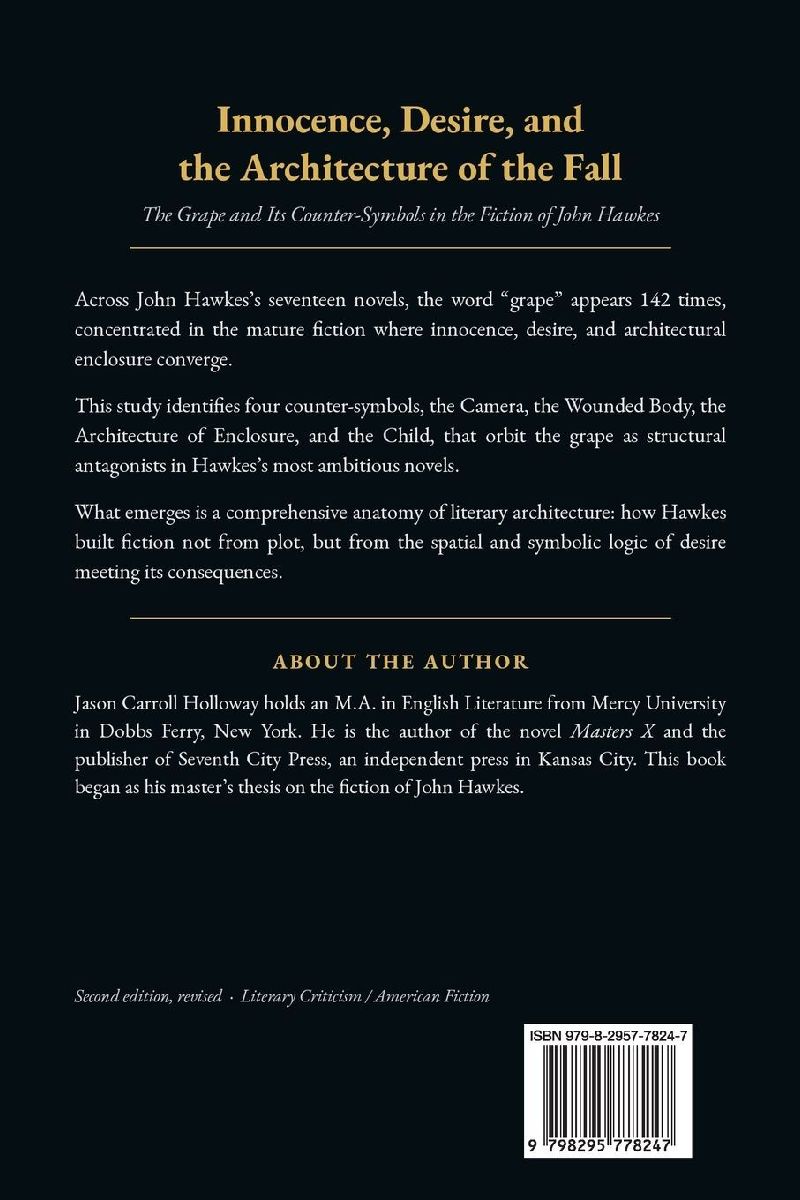
Across John Hawkes's seventeen novels, the word "grape" appears 142 times, concentrated in the mature triad and codified in Innocence in Extremis (1985). But the grape does not operate alone. This study traces a five-part symbolic architecture around it: the grape as threshold catalyst, surrounded by four counter-symbols (the camera, the wounded body, the enclosure, and the child), each defined by its relationship to the others.
Working in the tradition of Franco Moretti's distant reading and Matthew Jockers's macroanalysis, and extending the Hawkes scholarship of Greiner, Kuehl, and Ferrari, Jason Carroll Holloway combines close reading with keyword analysis to show Hawkes as more deliberately architectural, and more internally consistent, than criticism has yet recognized. The debris of his fiction reveals its innate design.
This second edition re-runs every count on digital texts of the novels, checks every quotation and page reference against the editions, and corrects the first edition throughout.
Essential reading for scholars of postwar American experimental fiction, and for every reader who has finished The Blood Oranges or Travesty suspecting the pattern was load-bearing.