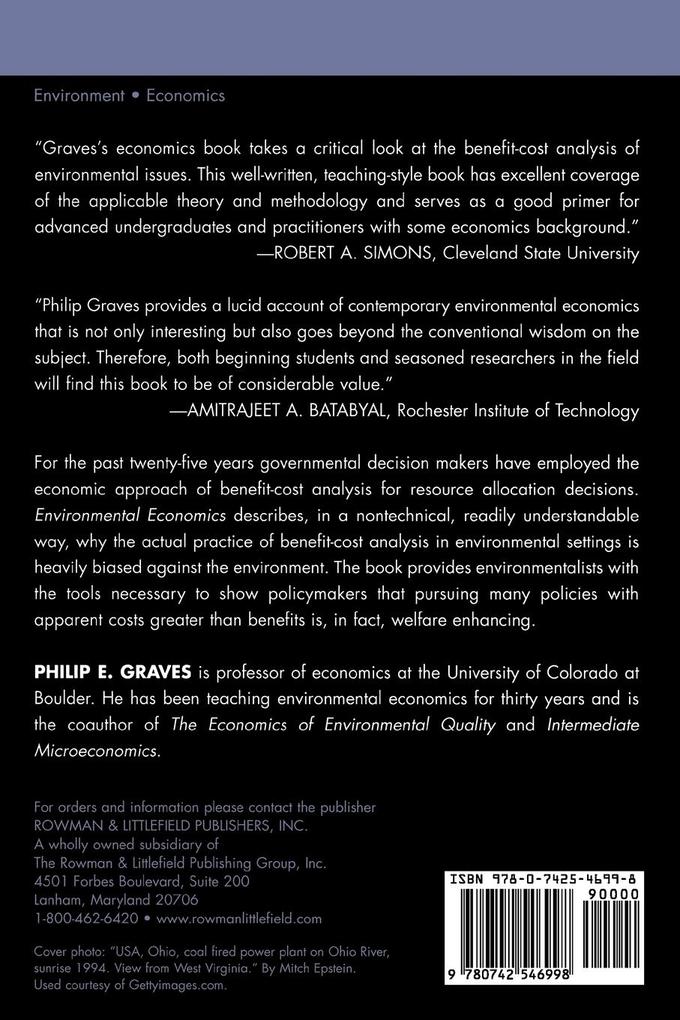
Environmental Economics: A Critique of Benefit-Cost Analysis describes, in a non-technical, readily understandable way, why the practice of benefit-cost analysis in environmental settings is heavily biased against the environment. The book provides environmentalists with the tools necessary to show policy-makers that pursuing many policies with apparent costs greater than benefits are, in fact, welfare-enhancing.
Inhaltsverzeichnis
Part 1 Part I: Economics Background-Why Economists Like Benefit-Cost Analysis
Chapter 2 1 Introductory Matters of Logic and Philosophy
Chapter 3 2 Why Economists Like Market Outcomes for Ordinary Goods
Chapter 4 3 Benefit-Cost Analysis when Information Is "Perfect": The Role of Time in Environmental Economic Decisions
Part 5 Part II: "Missing Markets": Externalities, Public Goods, and Property Rights
Chapter 6 4 Externalities as "Missing Markets"
Chapter 7 5 Public Goods as "Missing Markets"
Chapter 8 6 Property Rights as a Potential Solution to Environmental Problems
Part 9 Part III: Important Theoretical Problems with Implementing Benefit-Cost Analysis
Chapter 10 7 The Well-Known "Demand Revelation" Problem Out of a Given Income
Chapter 11 8 A Less-Well-Known "Supply Revelation" Problem
Part 12 Part IV: Practical Problems with the Implementation of Benefit-Cost Analysis
Chapter 13 9 Approaches to Estimating the Costs of Environmental Control Policies
Chapter 14 10 Overview of Approaches to the Valuation of Benefits of Environmental Policies
Chapter 15 11 Voting as a Way to Infer Environmental Benefits
Chapter 16 12 Constructed Markets: Stated Preferences and Experiments to Infer Environmental Benefits
Chapter 17 13 The Sum of Specific Damages Approach
Chapter 18 14 Hedonic Methods of Valuing Environmental Amenities
Chapter 19 15 Travel Cost Method of Valuing Environmental Amenities
Chapter 20 16 Political and Jurisdictional Problems
Part 21 Epilogue