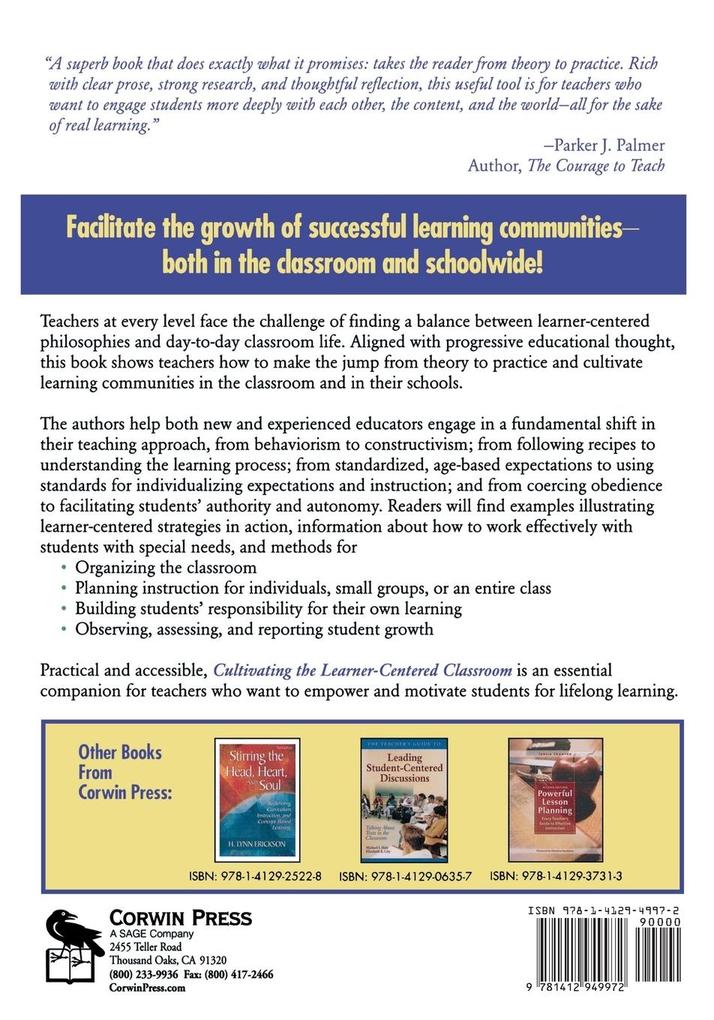
Cultivating the Learner-Centered Classroom, a progressively-oriented guide for teaching, provides teachers with concrete strategies for making a fundamental shift in educational thought and in practice: from behaviorism to constructivism, from control to cooperation, from following recipes to understanding the learning process, from meeting standards to individualizing expectations and instruction, and from coercing students' obedience to facilitating their authority and autonomy. The authors offer practical procedures and strategies that are aligned with progressive educational thought, and bridge theory and practice concerning the following aspects of teaching:
1) facilitating community development in the classroom
2) facilitating community development with parents
3) classroom organization
4) observing and assessing student growth 5) planning instruction
6) individual, small group, and whole group instruction
7) evaluating and reporting student growth
Inhaltsverzeichnis
Preface
Time to Learn
Fighting for Hope
Acknowledgments
About the Authors
Introduction: Progressivism and Traditionalism-A Continuum of Educational Thought
1. Facilitating Community Development in the Classroom
The Teacher's Essential Attributes: Confidence and Humility, Compassion and Faith
The Basis of the Teacher-Student Relationship: Motivation or Coercion?
Who Decides Who Belongs? A Note on Inclusive Education
From Theory to Practice: Strategies for Facilitating Relationship and Community
2. Classroom Organization
Finding You in Your Classroom
From Theory to Practice: Strategies for Organizing a Learner-Centered Classroom
3. Observing and Assessing What Students Know and Can Do
Understanding Terminology
Assumption #1: You Can't Teach Someone You Don't Know
Assumption #2: You Will Assess What You Value
Assumption #3: You Will Never Finish Learning How to Assess Students' Knowledge
From Theory to Practice: Strategies for Assessing What Students Know and Can Do
4. Planning Instruction
From Theory to Practice: Strategies for Planning Instruction
5. Evaluating and Reporting Student Growth
Common Assumptions About Grades
A Brief History of Grading
Evaluation as Grading: Critiquing Traditional Purposes of Letter Grades
Learner-Centered Evaluation: Reframing the Purpose of Grading
From Theory to Practice: Strategies for Evaluating and Reporting Student Progress
6. Facilitating Community Development With Parents
From Theory to Practice: Strategies for Facilitating Community Development With Parents
7. Holding On: Leading With Heart
On Becoming a "Real" Leader
Democratic Faith: The Final, Essential Component of Leadership
From Theory to Practice: Strategies for Holding On and Leading With Heart
References
Index