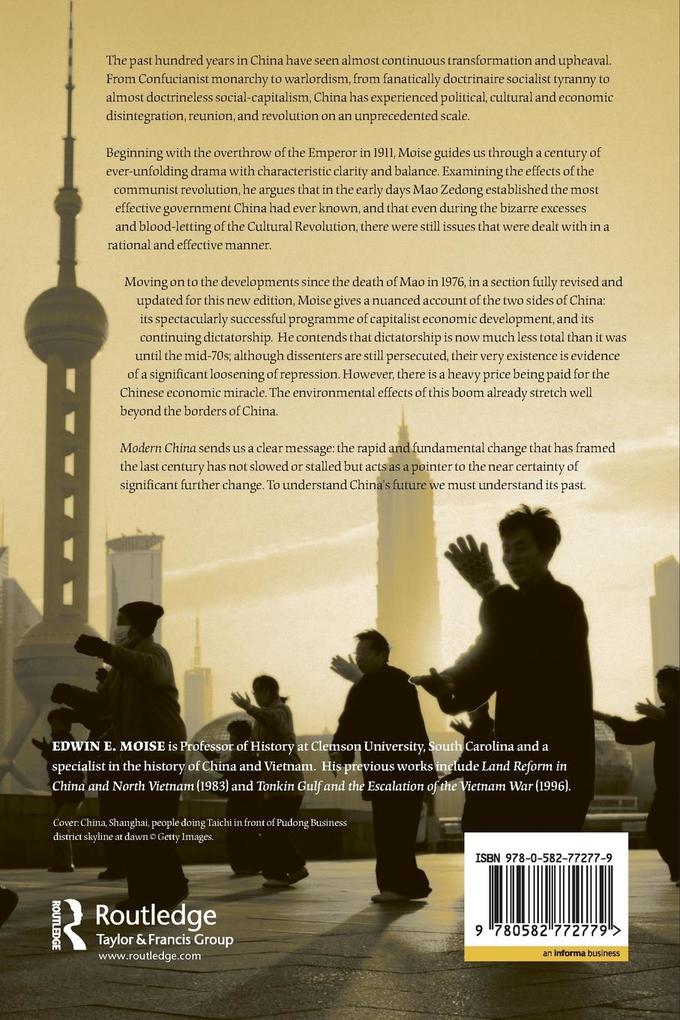
The past hundred years in China have seen almost continuous transformation and upheaval. From Confucianist monarchy to warlordism, from fanatically doctrinaire socialist tyranny to almost doctrineless social-capitalism, China has experienced political, cultural and economic disintegration, reunion, and revolution on an unprecedented scale.
Beginning with the overthrow of the Emperor in 1911, Moise guides us through a century of ever-unfolding drama with characteristic clarity and balance.
Modern China sends us a clear message: the rapid and fundamental change that has framed the last century has not slowed or stalled but acts as a pointer to the near certainty of significant further change. To understand China’s future we must understand its past.
Inhaltsverzeichnis
List of maps. List of illustrations. Acknowledgements. Introductory note: Chinese names and Chines geography 1. The Chinese Past. 2. The collapse of the old order. 3. The Communist Party and the First United Front. 4. The Nanjing decade, 1927-37. 5. World war and Communist victory. 6. The People's Republic of China, 1949-57. 7. The Great Leap and the great split. 8. The Cultural Revolution. 9. The post-Mao reforms. 10. The era of Deng Xiaoping. 11. The boom years. Suggestions for further reading. Index.