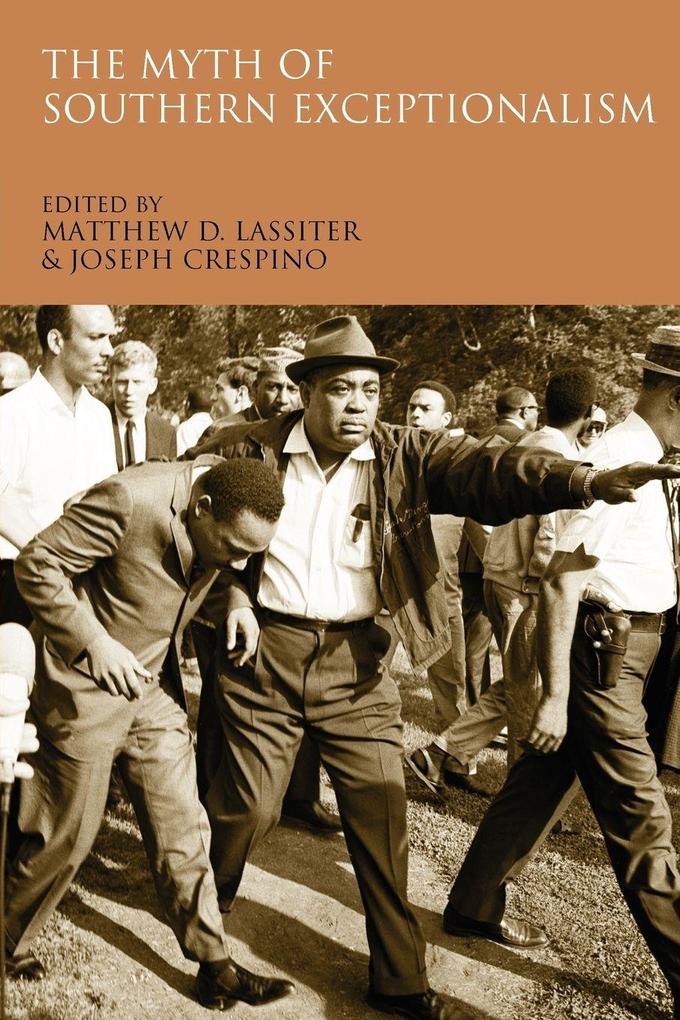
More than one-third of the population of the United States now lives in the South, a region where politics, race relations, and the economy have changed dramatically since World War II. Yet historians and journalists continue to disagree over whether the modern South is dominating, deviating from, or converging with the rest of the nation. Has the time come to declare the end of southern history? And how do the stories of American history change if the South is no longer seen as a region apart--as the conservative counterpoint to a liberal national ideal?
The Myth of Southern Exceptionalism challenges the idea of southern distinctiveness in order to offer a new way of thinking about modern American history. For too long, the belief in an exceptional South has encouraged distortions and generalizations about the nation's otherwise liberal traditions, especially by compartmentalizing themes of racism, segregation, and political conservatism in one section of the country. This volume dismantles popular binaries--of de facto versus de jure segregation, red state conservatism versus blue state liberalism, the "South" versus the "North"--to rewrite the history of region and nation alike.
Matthew Lassiter and Joseph Crespino present thirteen essays--framed by their provocative introduction--that reinterpret major topics such as the civil rights movement in the South and the North, the relationship between conservative backlash and liberal reform throughout the country, the rise of the Religious Right as a national phenomenon, the emergence of the metropolitan Sunbelt, and increasing suburban diversity in a multiracial New South. By writing American history across regional borders, this volume spends as much time outside as inside the traditional boundaries of the South, moving from Mississippi to New York City, from Southern California to South Carolina, from Mexico to Atlanta, from Hollywood to the Newport Folk Festival, and from the Pentagon to the Attica prison rebellion.
Inhaltsverzeichnis
- Introduction: The End of Southern History
- Part One: The Northern Mystique
- 1: Matthew D. Lassiter: De Jure/De Facto Segregation: The Long Shadow of a National Myth
- 2: Jeanne Theoharis, Brooklyn College, CUNY: Hidden in Plain Sight: The Civil Rights Movement outside the South
- 3: Heather Ann Thompson, University of North Carolina at Charlotte: Blinded by a "Barbaric" South: Prison Horrors, Inmate Abuse, and the Ironic History of American Penal Reform
- Part Two: Imagining the South
- 4: Joseph Crespino: Mississippi as Metaphor: Civil Rights, the South, and the Nation in the Historical Imagination
- 5: Grace Elizabeth Hale, University of Virginia: Black as Folk: The Southern Civil Rights Movement and the Folk Music Revival
- 6: Allison Graham, University of Memphis: Red Necks, White Sheets, and Blue States: The Persistence of Regionalism in the Politics of Hollywood
- Part Three: Border Crossings
- 7: James T. Sparrow, University of Chicago: A Nation in Motion: Norfolk, the Pentagon, and the Nationalization of the Metropolitan South, 1941-1953
- 8: Kari Frederickson, University of Alabama: The Cold War at the Grassroots: Militarization and Modernization in South Carolina
- 9: Andrew Wiese, San Diego State University: African-American Suburbanization and Regionalism in the Modern South
- 10: Mary E. Odem, Emory University: Latin American Immigration and the New Multiethnic South
- Part Four: Political Realignment
- 11: Douglas Smith, Occidental College: Into the Political Thicket: Reapportionment and the Rise of Suburban Power
- 12: Kevin M. Kruse, Princeton University: Beyond the Southern Cross: The National Origins of the Religious Right
- 13: Nancy MacLean, Northwestern University: Neo-Confederacy against the New Deal: The Regional Utopia of the Modern American Right