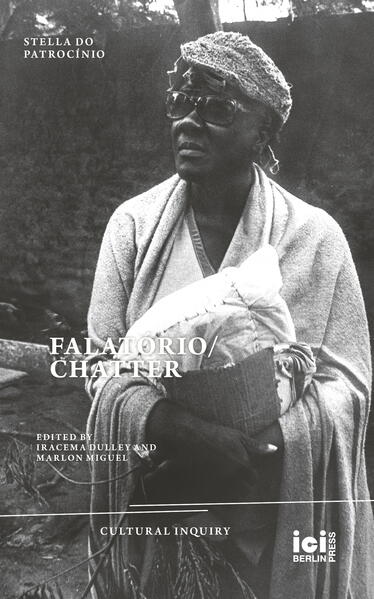
Stella do Patrocínio is a force to be reckoned with. Through her falatório / chatter, she liberates herself from the stigma of exclusion, offering a transformative interpretation of Brazil. From within the thick walls of a former sugar plantation turned mental asylum, her poetry chronicles how historical marginalization bred psychiatric violence in twentieth-century Brazil, straddling both dictatorial and democratic regimes. Those who, like her, entered confinement from the lower rungs of Brazilian society, endured a compounded erasure from historical and literary canon. Stella, however, breaks the mould by claiming authority over her own body and artistic expression. In this fascinating collection of all known materials produced by her at the Colônia Juliano Moreira, Iracema Dulley and Marlon Miguel create a new and sympathetic record of Stella s embodied poetic practice. Offered for the first time in Portuguese and English translation, the book presents Stella alongside short commentaries from those who knew or studied her. Ultimately, even if mediated by transcription, Stella s voice continues to urge us to listen in for social justice. In Falatório, readers will find both wisdom and sorrow paving the way for Black intellectual history in Brazil. Isadora Moura Mota, Assistant Professor of History, Princeton University
There are moments in every reader s life, where they encounter a book, that by its very nature and form, speaks a kind of unsullied truth. This marvelous volume is the exemplar of just such a text. Speaking to and with the marginalized figure of Stella do Patrocínio, the authors trace (among other things) the institutional link that marked and attempted to confine her falatório. While there is much to celebrate in this earnest and serious monograph, it is the manner in which the archival materials are handled and worked with that brought home to me the ethical sensibilities that undergird the work from start to finish. A lucid and challenging rendering of a historical figure who speaks directly to many of our current dilemmas. Psychoanalysis as a field is better situated as the result of this book. I give it my highest recommendation. Fernando Castrillón, Editor-in-Chief, European Journal of Psychoanalysis
In Brazil, after the Abolition period, Black people were forced to confront treatments supposedly grounded in modern, racist `science treatments that questioned their sanity and policed their bodies. Whole lives were often confined within asylum walls for nothing more than a sudden episode in the street, or a gesture deemed `deviant. One such trap ensnared Stella do Patrocínio. The recovery of some surviving voices has become an act of resistance and remembrance. Stella do Patrocínio never stopped speaking, creating her Falatório/Chatter. Since the 1990s, women researchers have listened to her, recording and studying her words to illuminate the strength of her thought and art. From the right to memory to a renewed place in psychology; from literary studies to poetic dialogue, and now reaching into the fields of social sciences and philosophy, Iracema Dulley and Marlon Miguel join an increasingly bold critical movement that reflects on the life and voice of Stella do Patrocínio. Together, they unearth from the ruins of violent modernity what it could never contain: the force of insubordination, the desire to create, a thought unbound by language itself. This Falatório/Chatter, now translated into English, stands as living proof. Mário Augusto Medeiros da Silva, writer and sociologist at University of Campinas (Brazil).