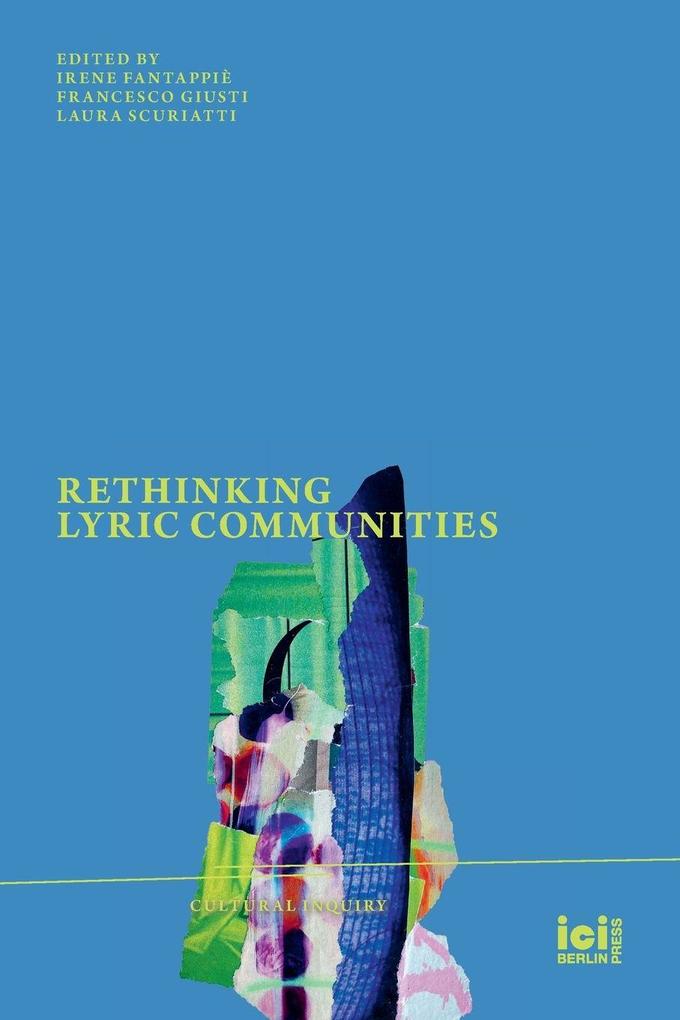
Rethinking Lyric Communities is an exciting contribution to work on lyric poetry. Exploring modern and contemporary literatures in various languages, it recasts the lyric not as the overheard inner thoughts of an isolated individual but a calling into being of potential collectivities. And community is reconceptualized not as a pregiven, closed, organic unit but the shifting, open-ended social worlds that lyric identifications and iterations, anthems and apostrophes, performances and gestures, creoles and translations help us imagine. Rich with insight and provocation, this is a volume to be reckoned with for years to come. Jahan Ramazani, author of Poetry in a Global Age.
In premodern times lyric poetry was understood to build or strengthen several kinds of communities: ones of poetic filiation, social positioning, political grouping, religious bonding, affective engagement, and spiritual connection. In Rethinking Lyric Communities, Francesco Giusti, Irene Fantappiè, and Laura Scuriatti draw together contributions from diverse languages, epochs, and traditions, to investigate how poetry can form communities in the modern age. Under four headings Indexicality, Identification, Individuation, Translation the contributions cumulatively build up a fascinating picture of how often resistant communities can be born out of the most unlikely practices. Perspectives range from the conviviality of the early twentieth century salon to illegal gatherings in the Soviet Union; from Queer communities to football chants or translation as repair; from colonialism to cruising. This brilliantly poised examination is full of surprises and balances attention to theory with illuminating close reading to demonstrate that poetry can make things happen. The whole concludes with a fine conversation with the poet Vahni Anthony Capildeo who brings a practitioner s perspective to bear on how fragile communities can be shaped out of the quintessential loneliness of the writer and how poems can crystallize values about which readers in turn can coalesce. In times in which poetry is often thought isolated and ineffectual, this is vital reading of the very best kind. Karen Leeder, Schwarz-Taylor Chair of German Language and Literature, University of Oxford, Einstein Visiting Fellow, Freie Universität Berlin and editor of Flaschenpost: German Poetry and the Long Twentieth Century.