Strategic alliances challenge conventional theories of the firm. Despite their rapid proliferation and the opportunities they present for firms, they are extremely difficult to manage. This book examines the main perspectives of strategic alliance, takes stock of the evidence, and indicates prospects for a better understanding of this complex phenomenon.
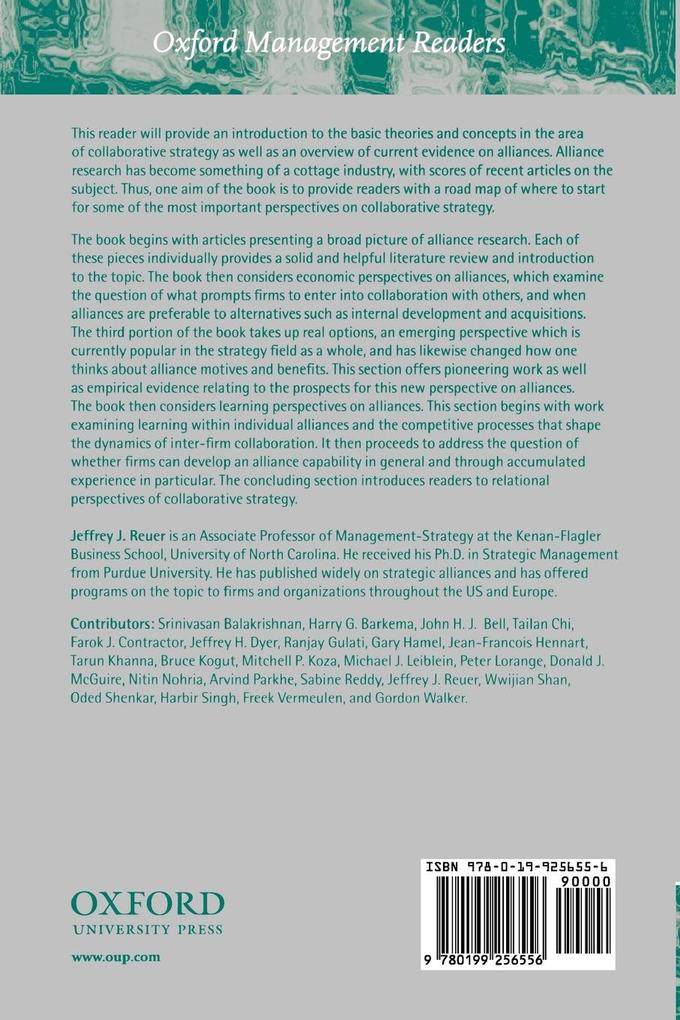
This reader will provide an introduction to the basic theories and concepts in the area of collaborative strategy as well as an overview of current evidence on alliances. Alliance research has become something of a cottage industry, with scores of recent articles on the subject. Thus, one aim of the book is to provide readers with a road map of where to start for some of the most important perspectives on collaborative strategy.
The book begins with articles presenting a broad picture of alliance research. Each of these pieces individually provides a solid and helpful literature review and introduction to the topic. The book then considers economic perspectives on alliances, which examine the question of what prompts firms to enter into collaboration with others, and when alliances are suitable relative to alternatives such as internal development and acquisitions. The third portion of the book takes up real options, an emerging perspective which is currently popular in the strategy field as a whole, and has likewise changed how one thinks about alliance motives and what determines the usefulness of short-lived collaborations for parent firms. This section offers the pioneering piece as well as some empirical evidence relating to the prospects for this new perspective on alliances. The book then considers learning perspectives on alliances. This section begins with work examining learning within individual alliances and the competitive processes that shape the dynamics of inter-firm collaboration. It then proceeds to address the question of whether firms can develop an alliance capability in general and through accumulated experience in particular. The concluding section introduces readers to relational perspectives of collaborative strategy.
Inhaltsverzeichnis
- Introduction - Strategic Alliance Research: Progress and Prospects
- Part I: Overview of Research on Interfirm Collaboration
- 1: Farok. J. Contractor and Peter Lorange: Why Should Firms Cooperate? The Strategy and Economics Basis for Cooperative Ventures
- 2: Bruce Kogut: Joint Ventures: Theoretical and Empirical Perspectives
- 3: Arvind Parkhe: International Joint Ventures
- Part II: Economic Perspectives on Interfirm Collaboration
- 4: Jean-Francois. Hennart: A Transaction Cost Theory of Equity Joint Ventures
- 5: Srinivasan Balakrishnan and Mitchell P. Koza: Information Asymmetry, Adverse Selection, and Joint Ventures
- 6: Jean-Francois Hennart and Sabine Reddy: The Choice Between Mergers/Acquisitions and Joint Ventures: The Case of Japanese Investors in the United States
- 7: Jeffrey. J. Reuer and Mitchell P. Koza: Asymmetric Information and Joint Venture Performance: Theory and Evidence for Domestic and International Joint Ventures
- Part III: Real Options Perspectives on Interfirm Collaboration
- 8: Bruce Kogut: Joint Ventures and the Option to Expand and Acquire
- 9: Tailan Chi and Donald J. McGuire: Collaborative Ventures and Value of Learning: Integrating the Transaction Cost and Strategic Option Perspectives on Foreign Market Entry
- 10: Jeffrey J. Reuer and Michael J. Leiblein: Downside Risk Implications of Multinationality and International Joint Ventures
- Part IV: Learning Perspectives on Interfirm Collaboration
- 11: Gary Hamel: Competition for Competence and Interpartner Learning Within International Strategic Alliances
- 12: Tarun Khanna, Ranjay Gulati, and Nitin Nohria: The Dynamics of Learning Alliances: Competition, Cooperation, and Relative Scope
- 13: Harry G. Barkema, Oded Shenkar, Freek Vermeulen, and John H. J. Bell: Working Abroad, Working with Others: How Firms Learn to Operate International Joint Ventures
- Part V: Relational Perspectives on Interfirm Collaboration
- 14: Jeffrey H. Dyer and Harbir Singh: The Relational View: Cooperative Strategy and Sources of Interorganizational Competitive Advantage
- 15: Ranjay Gulati: Alliances and Networks
- 16: Gordon Walker, Bruce Kogut, and Wwijian Shan: Social Capital, Structural Holes, and the Formation of an Industry Network